
What is BIM?
BIM is a process for creating and managing information on a construction project throughout its whole life cycle. As part of this process, a coordinated digital description of every aspect of the built asset is developed, using a set of appropriate technology. It is likely that this digital description includes a combination of information-rich 3D models and associated structured data such as product, execution and handover information.
Internationally, the BIM process and associated data structures are best defined in the ISO 19650 and 12006 series of standards.
What is BIM? A video guide
At our Construction Leaders’ Summit, we asked some of those who practise BIM in the UK for their views on what BIM means to them. The following video outlines many of the benefits of BIM.
At NBS, we have created an integrated platform for everyone involved in the design, supply and construction of the built environment. The following video shows designers collaborating online, and working with construction manufacturers to generate the information that is needed by those working in construction and operations.
How can BIM help you?
In the early stages of a BIM project, a collaborative team is assembled. It agrees the process and information structures to ensure that the design information developed is coordinated, and will be of maximum benefit to those involved in the construction and operation stages. Involvement of those that will be involved at a later stage of the project (such as manufacturers or the client’s FM team) can greatly help with this initiation.
As the project enters the construction stage, the information developed can be used to plan and build more efficiently. Where revisions to the design are required, any changes can follow the agreed process in a transparent and recorded way.
Finally, as the construction project is completed and the in-use stage commences, the information that has been modelled can be used to operate the built asset. Real-time information about the asset’s performance is modelled so that certain aspects of the built asset have a ‘digital twin’ equivalent.
What are the BIM standards?
There are a number of standards that define BIM information structures and processes internationally.
Information structures:
- ISO 16739-1:2018 – ‘Industry Foundation Classes (IFC) for data sharing in the construction and facility management industries — Part 1: Data schema’.
- ISO 12006-2:2015 – ‘Building construction - Organization of information about construction works - Part 2: Framework for classification’. The UK National Foreword of this standard lists Uniclass 2015 as the classification system for UK BIM.
- ISO 23386:2020 – ‘Building information modelling and other digital processes used in construction — Methodology to describe, author and maintain properties in interconnected data dictionaries’. At NBS, we follow this framework when modelling information structures with manufacturers in the NBS Source platform.
Processes:
- UK BIM Framework – the ISO 19650 series of standards defines the BIM process internationally. These had their basis in the UK PAS 1192 series of standards. The UK BIM Framework website has further information on these standards, and extensive free-to-use guidance resources.
What are BIM dimensions?
BIM dimensions have evolved from a need to differentiate between modelling geometry in two dimensions or three dimensions. This has been part of the modelling evolution, moving from drawing boards to the first 2D CAD systems, to 3D modelling packages.
Adding further aspects to this modelling can help project teams understand what information they are setting out to model. 4D is commonly known as ‘modelling scheduling information to model construction sequences’. 5D is known as ‘adding financial cost’. There is little international consensus beyond this, and arguably cost isn’t a ‘dimension’ at all – it is just a further information field.
At NBS, and in the international standards, these dimensions are not typically referred to. If specific information is required to be modelled, it is far better to be clear on precisely what this information is than to use terminology such as 5D, 6D or 7D, etc.
For more information, see the article BIM dimensions explained.What is a BIM object?
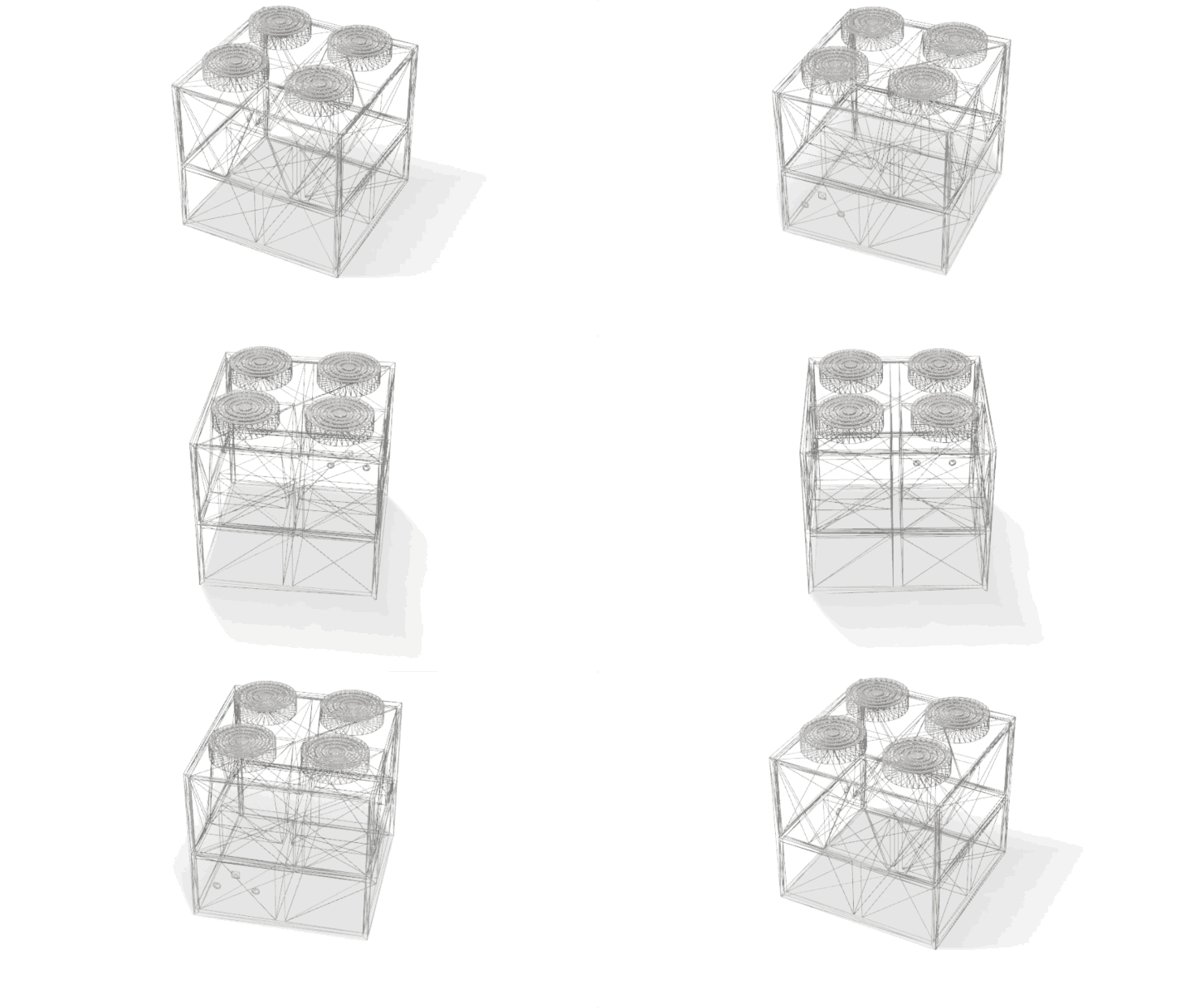
A BIM object is a combination of many things.
It is detailed information that defines the product, and geometry that represents the product’s physical characteristics. The visualization data that gives the object a recognizable appearance and behavioural data, such as detection zones, enables the object to be positioned or to behave in exactly the same way as the product itself. There are two primary types of object: component and layered. The component objects are building products that have fixed geometrical shapes (such as windows, doors, boilers, etc.). Layered objects are building products that do not have a fixed shape or size (such as carpets, roofing, walls and ceilings).
How do specifications fit into the BIM process?
Specifications are a huge part of the BIM process. Each discipline involved in designing the built asset needs to specify their requirements. Throughout the project timeline, this specification information should develop from a description of the required performance outcome through to a prescriptive solution of systems and products that meet this performance. Finally, these specifications should be updated throughout the construction phase so that the client may receive a set of record specifications at handover.
This information should be authored to a standard structure and coordinated with the information in any 3D models, and in related databases.
At NBS, our Chorus platform helps organizations to create specifications to the Uniclass 2015 data structure, and to publish this information following the process defined in the ISO 19650 series of standards.
What is the future of BIM?
The leading edge of the industry will continue to innovate. Our annual NBS digital surveys show that cloud computing, the Internet of Things, Blockchain, artificial intelligence and modern methods of construction are all on the rise.
However, for the majority of the industry, the future is about making the existing information structures and processes ‘business as usual’. These are mainly training, education and cultural challenges. But technology can also help. As platforms mature, the manual tasks of structuring data, classifying data and naming files will be automated. This will enforce the structure and the process, and help accelerate BIM.
In the future, there will be a golden thread of information that is collaboratively developed in parallel to the design and construction of built assets. This will be a record of what has been built, developing a record of how the asset is performing. Across client estate – or even national – boundaries, this will in time be the ‘big data’ that helps decision makers continuously improve to build a safer and more sustainable built environment.
Free to watch on-demand webinars:
- NBS Chorus Masterclass: Model integration with Revit - One of the key benefits of Chorus is the ability to develop your specification and design model together directly within the Autodesk Revit® environment, keeping your information co-ordinated and creating a seamless link between your design and spec. Join our next masterclass, hosted by Nick Armitt, NBS trainer, to learn how the feature works and how to make the most of it on your projects.
- The benefits of BIM content and 3D visualisation - Join Lee Jones, Head of Manufacturer Solutions at NBS, and Daniel Stine, Director of Design Technology at Lake Flato, as they explore the benefits of BIM content and 3D visualisation on construction projects.
Useful links:
- Uniclass – https://uniclass.thenbs.com/
- NBS Chorus – https://www.thenbs.com/nbs-chorus
- RIBA Plan of Work – https://www.architecture.com/knowledge-and-resources/resources-landing-page/riba-plan-of-work
- UK BIM Framework – https://www.ukbimframework.org/