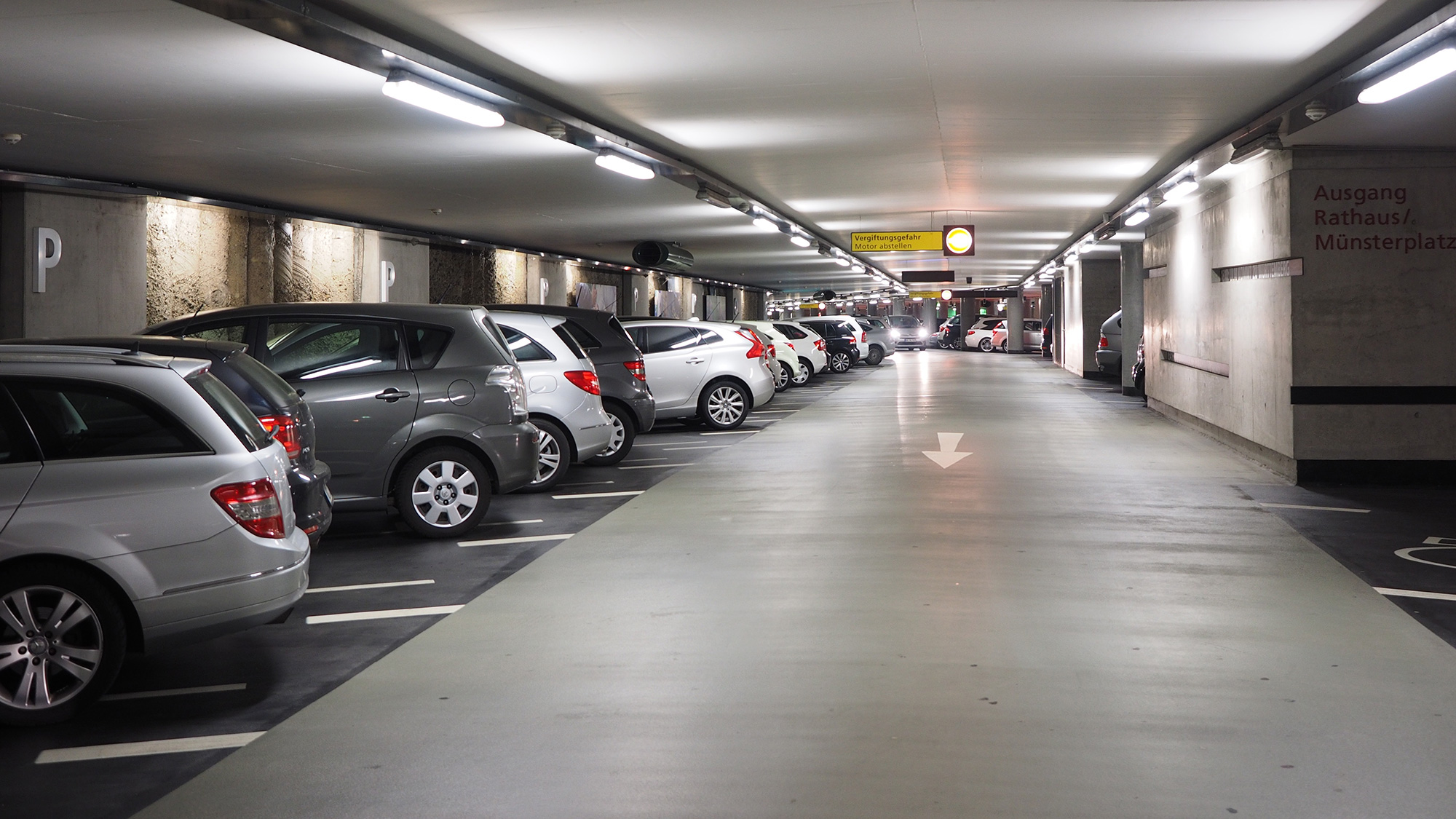
Despite their seeming simplicity, the design of a car park on multiple levels – whether above ground or below – involves the consideration of a number of significant requirements. These range from efficient circulation to structural matters, crime prevention and health & safety aspects. The various subject areas are discussed in more detail below.
Planning and layout
The first consideration for the layout of a car park is the number of vehicles to be accommodated, compared with the space available. Cost constraints for excavation in the case of underground car parks, for example, need to be factored in. Vehicle flow rates will need to be factored in to calculations for the number of spaces to be provided to meet demand at peak times in, for example, a shopping centre or hospital.
Multi storey car parks generally fall in to one of a number of basic layout types:
- Flat deck
- Split level
- Sloping deck (or ‘ramped floor’)
Vehicle access to parking areas can be via:
- External ramps
- Internal ramps
- End or centre ramps, or a combination
- vehicle lifts
Similarly, vehicle circulation can be organized by:
- Combined or separate entry/exit
- One-way or two-way traffic
Having established these basic parameters, the primary generator of the layout of a car park is the size and constraints of the vehicles that will use it. Whilst in the main this will typically be cars (and to some extent motor cycles), larger vehicles such as fire appliances or ambulances will also need to be considered. Geometrical requirements include turning circles, swept paths and ramp gradients.
Notable requirements under the Building Regulations include fire resistance and means of escape (Part B), accessibility (Part K and Part M) and guardings (Part K). Common vehicle space standards and dimensions can be found in the New Metric Handbook, in addition to Local Authority highway design guides and the Institution of Structural Engineers publication, Design recommendations for multi-storey and underground car parks.
Usage matters that affect the design include payment methods (pay machines on parking decks or in stair lobbies, or pay-by-phone) and grace periods allowed after payment, prior to vehicle exit (if pay-on-exit is selected).
Safety and security
Crime-related issues are well covered by the Safer Parking Scheme publication, Park Mark Safer Parking Scheme – New Build Car Park Guidelines for car park designers, operators and owners:
Design principles
- Owners and operators obligations under the Health & Safety at Work Act, as amended by S I N o. 2174/2002 concerning the ‘stability and solidity’ of employment premises.
- Occupiers Liability Act 1957 covers the safety of persons entering the premises – lawfully of otherwise.
Boundaries and Perimeters
- Defensible boundaries – multi storey car parks can use perimeter walls and structure. But barriers need consideration.
- Anti-climb measures may also be needed for high suicide risk locations such as hospitals.
Lighting
- Lighting should be even, to eliminate shadows.
- White (or light-coloured) walls, floors and ceilings can reduce the quantity of luminaires needed.
- Lighting to BS 5489-1:2013 and BS EN 12464-1:2011.
- Anti-vandal cabling.
- Siting of lighting columns to avoid being used as climbing aids.
Management Practice
- Accessibility of attendants via phones, kiosks, AV links, panic alarms.
- Anti-vandalism measures including anti-graffiti coatings, easy clean surfaces.
- Climbing plants can reduce vandalism.
- Subscribe to the Safer Parking Scheme.
Parking Areas or Decks
- An access control system is. Important, especially for underground (e.g. private residential) car parks.
- Specify inward-opening automatic gates or roller grilles/shutters (certified to LPS 1175 SR2 or WCL 2 BR2), to avoid creating a recess), but check against means of escape requirements.
- Rough surfaces to ramps can deter skateboarding.
- One-way circulatory traffic, clear direction arrows, speed restrictors.
- Clearly define pedestrian routes.
- Anchor points for motorcycles and bicycles.
- Site any payment machines in the busiest areas.
Vehicular Access
- Ideally the entry and exit should be close together, but separate to one another.
- Consider height restrictors (but capable of over-ride for emergency or maintenance vehicles).
Pedestrian Access
- Specify vandal-resistant lifts, and glazed lobby doors.
- Avoid long passageways.
- Perforated or transparent balustrades aid visibility.
Signage
- Clear, visible, pictorial, colour coded, logical and informative.
- Use internationally-recognised pictograms.
Surveillance and CCTV
- Design-in passive surveillance features (refer to Secured by Design for principles and ideas). Minimise obstructions e.g. columns, for natural surveillance
- Comply with the CCTV Code of Practice, and register with the Information Commissioner, if filming/recording public areas.
- Comply with the Data Protection Act 1998.
Landscaping
- Specify plants with low natural growth rates (1m maximum pruned size).
- Plan a maintenance regime
- Spiky bushes are useful deterrents on boundaries.
Operator Requirements
- Safety for operators if on site, for example in public-facing kiosks.
Engineering – Structure
Multi storey car parks are essentially elementary building structures, albeit with certain specific performance criteria that must be met. The overall structural form will be heavily influenced by the design geometry adopted. Underground car parks will, to a large extent, be determined by the structure above (for example a multi storey building or a public garden).
The structural frame can be either reinforced concrete (precast units or cast in-situ), steel or a composite structure (steel beams and columns, supporting concrete floor slabs). Ribbed or coffered slabs are often used. Lightweight-aggregate concrete can reduce overall loadings significantly, and has better fire performance – but smaller span:depth ratios and additional shear reinforcement are needed.
Concrete must be designed to be durable against chemical corrosion attack. Non-slip finishes in particular to ramps are also prudent, to prevent skidding. Heated structures are also possible, although their effectiveness can be questionable.
Vehicular loading of buildings is covered in Section 6 of BS EN 1991-1-1. Parapet loading (impact resistance) for car parks is covered in Annex B of the same Eurocode. Wind loads and vibration also need to be taken into account. Structural resistance to explosions (over and above fire resistance) should also be considered. Underground car parks will need extensive retaining wall design, incorporating tanking and land drainage.
Engineering – Mechanical and Electrical
Car parks utilise impulse ventilation to expel carbon monoxide and other pollutants from deep-plan parking decks. This employs a number of small, high velocity fans in lieu of traditional ductwork, operating on the tunnel ventilation principle to direct airflow towards the main extract fan intake points. Noise control needs to be considered for air handling plant in noise-sensitive areas, or to comply with Local Authority bylaws or planning regulations.
All surface water in car parks has to be passed through a petrol interceptor before discharging to the main drainage system.
A full emergency lighting system will be needed, with backup supplies. This is in addition to a fire detection and alarm system, possibly with sprinklers where a fire-engineered design is needed, although consideration should be given to the choice and location of flame suppressant used, where vehicle fuel or electrical fires are a high risk.
Consideration should be given to the provision of electrical charging points for hybrid or electric cars. Underfloor heating is sometimes used, in particular on vehicle ramps to prevent skidding, although its effectiveness can be questionable.
Interested in more content like this? Sign up to the NBS eWeekly newsletter.