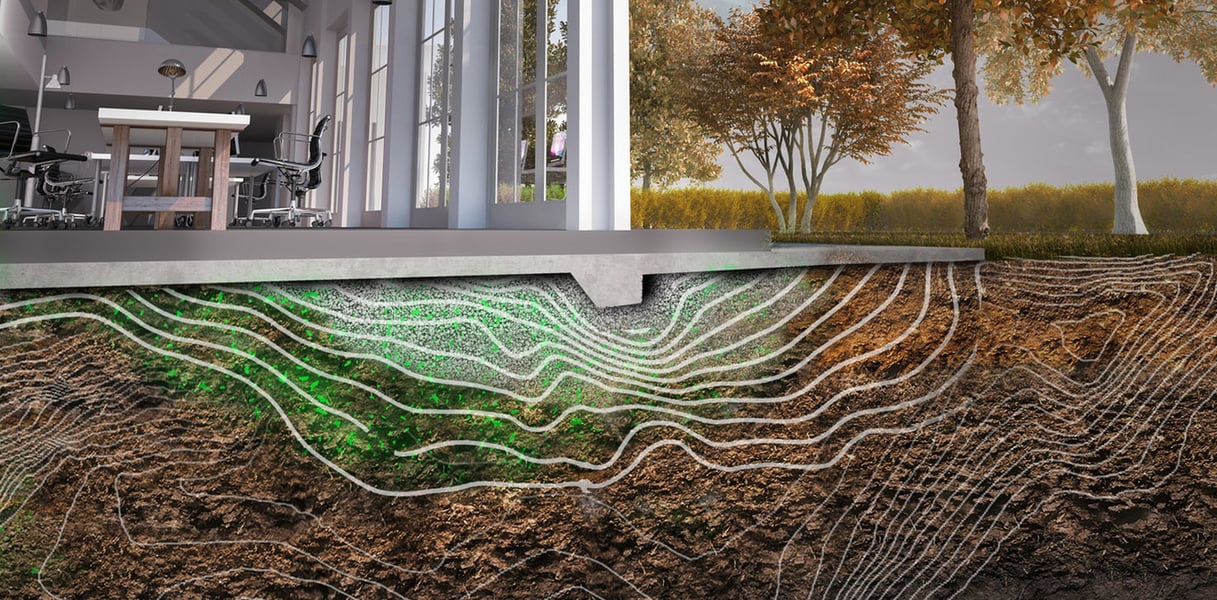
Image: Illustration of pressure sensing bacteria in soils from the ‘Computational Colloids Project’. Carolina Ramirez-Figuroa, Luis Hernan and Martyn Dade-Robertson, CC BY-SA
You might be disappointed to hear that some intriguing underwater structures recently discovered off the Greek island of Zakynthos are not part of the lost city of Atlantis. But the structures, which resemble colonnades of cobble stones and bases of columns, have an equally fascinating origin. They were actually constructed by microbes gathering around natural vents of methane and forming a natural cement in the otherwise soft sediment.
To some degree, these formations are an accident, sculpted by the interaction of the microorganisms with their physical and chemical environments. But they still point to a complex ability not usually associated with simple single-celled organisms less than 0.0002cm in diameter. So if bacteria can grow their own “cities”, could we use them to grow ours as well?
Bacterial building is actually more common than you might think. If you rub your tongue across the back of your teeth and find a rough spot between the base of the tooth and your gum you should probably go and see a dental hygienist. But you might also contemplate the fact that you have a city growing on your teeth. The rough patch, known more commonly as plaque, is a biofilm, a complex structure built by bacteria living in your mouth.
Researchers are now experimenting with using the building abilities of bacteria in the human world.
Biofilms are, in effect, buildings for bacteria. They provide the bacteria with physical protection and (unfortunately for us) protection from antibiotics. They also enable a complex communications network between the bacteria that lets them work together, with different groups of cells performing different functions and even helping control the populations.
Researchers are now experimenting with using the building abilities of bacteria in the human world. For example, we can make self-healing concretes that use bacteria to re-mineralise cracks. It is even possible to create bacteria-based bio-cements using a process similar to that which built the structures found in Zakynthos.
Both systems use a process known as biomineralisation, where bacteria cause mineral crystals to form by changing the chemical composition of their environment. In the case of self-healing concretes and bio-cements, they combine calcium found in their immediate environment with carbon from carbon dioxide in the air. The beauty of the process is that, unlike normal cements and concretes that produce a lot of carbon dioxide, this actually takes carbon out of the atmosphere.
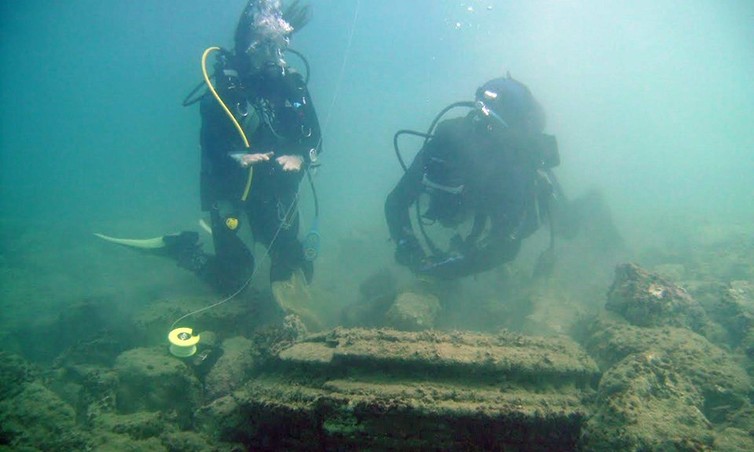 Underwater microbe ‘cities’ off Zakynthos (Image: University of East Anglia)
Under pressure
Our research takes this idea even further. We want to use the capacity of microorganisms to sense and respond to their environment, as well as add to it with their own structures. For example, imagine if we could lace the ground of a building site with bacteria that react when they feel mechanical pressure by binding the surrounding soil grains. This would mean we could create a self-constructing foundation just by putting the right amount of pressure on the ground, removing the need for costly excavations and reinforced concrete slabs.
Such a system may still be some way into the future but we have started down the path. Through the emerging discipline of synthetic biology we have already been able to identify genes in certain bacteria that activate in response to pressure. We’ve then used genetic engineering to design bacteria that glow when pressurised. Our next step is to begin to use this pressure-sensing capacity in the bacteria to trigger the the process of biomineralisation and the production of new binding materials including polymers.
The site off Zakynthos may have been an archaeological disappointment but it reveals something about the way we might construct buildings in the future. Imagine visiting the ancient remains of our microbial-built future cities. When the archaeologists assess whether they are natural or artificial they may not be able to tell.
This article was originally published on The Conversation. Read the original article.