- Three quarters now use BIM, compared to one in ten a decade ago
- Over half of BIM users say it makes them more profitable and more productive
- 71% say BIM makes projects safer
- One in three non-users say contracts haven’t caught up with technology
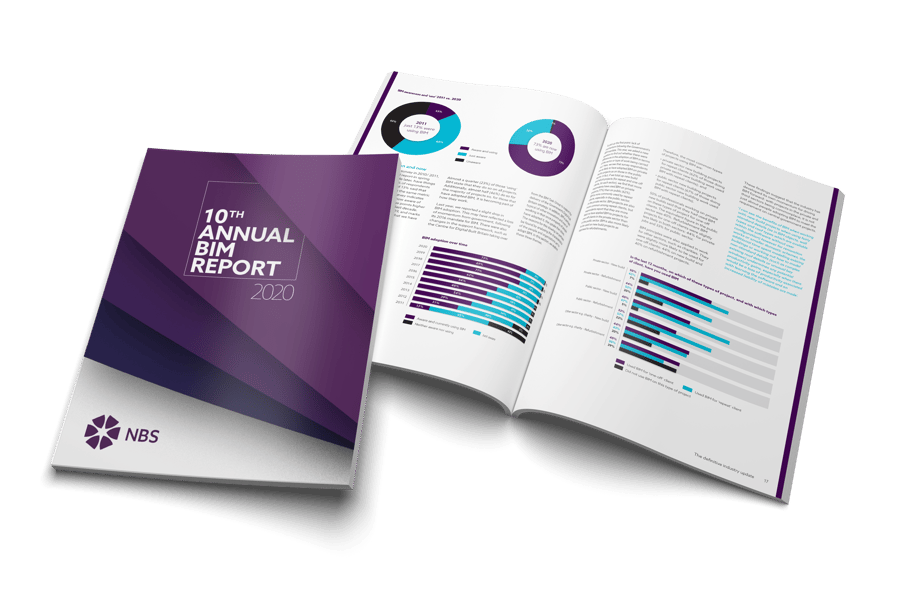
NBS, the leading provider of connected construction information, has released its tenth annual BIM report, which looks at the status of Building Information Modelling, a digital process used in the design, construction and maintenance of buildings.
Over a thousand construction professionals took part and three quarters (73%) of respondents are now using BIM. As it has become the standard approach, this is a dramatic change from a decade ago when just over one in ten were BIM users.
Almost a quarter (23%) of those ‘using’ BIM state that they do so on all projects. Additionally, around half (46%) do so for the majority of projects. For those who’ve adopted BIM, this approach is now part of their standard toolkit.
Making the jump
Implementing BIM can require businesses to invest time and a step-change in workflows and processes. Yet there are myriad benefits to be had.
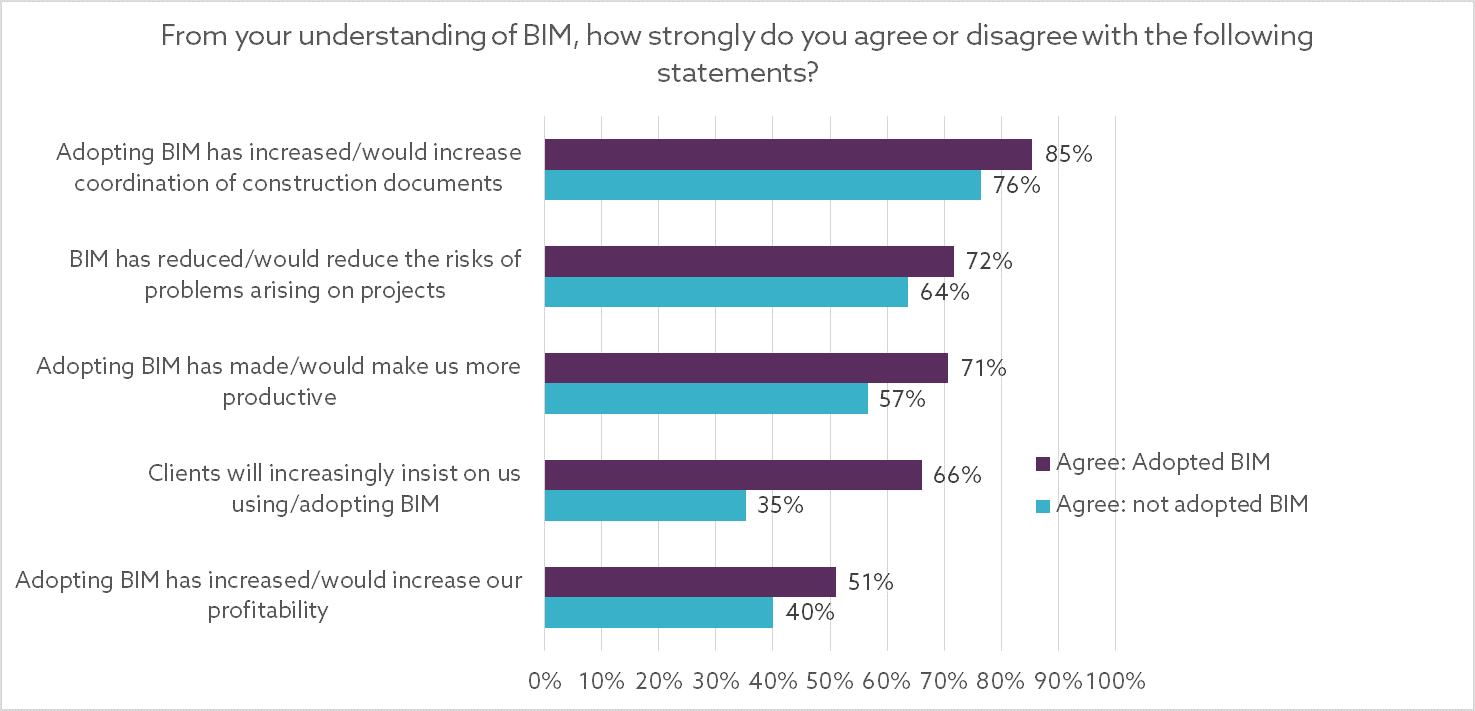
More than half (51%) of BIM adoptees say it made them more profitable and nearly three quarters (71%) say they’ve become more productive. Clients benefit too, with 74% of respondents reporting that using BIM delivers operational and maintenance savings.
BIM also drives collaboration, aiding in smooth project management: the vast majority of users (85%) say BIM increases project coordination, beyond this it de-risks projects with 72% of BIM users stating there is a reduction in problems arising. These are all positive outcomes for the companies completing construction projects and the clients commissioning them. It’s unsurprising, therefore, that almost two thirds of BIM users (66%) expect clients to insist on BIM.
Barriers
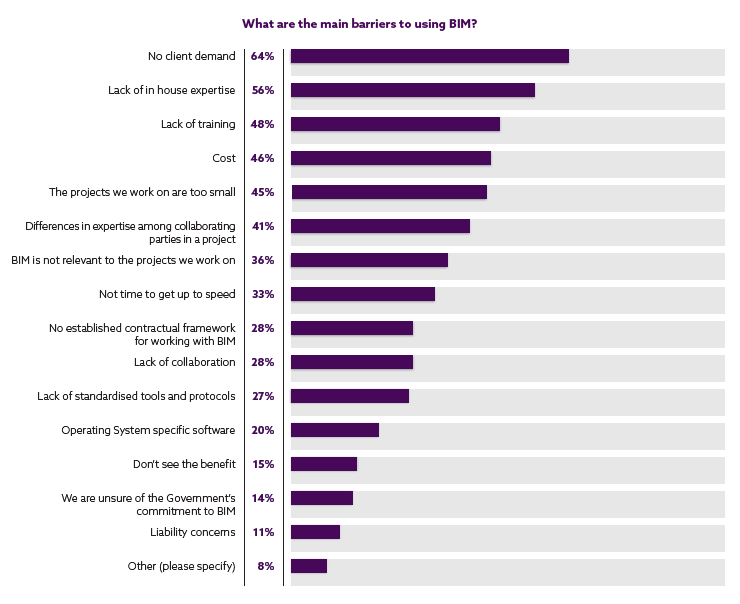
Despite the clear benefits for both users and clients, there are challenges to BIM adoption; lack of in-house expertise, training and cost persist. However, the number for each has dropped. Since last year, lack of expertise has fallen from 63% to 56%, training from 59% to 48%, and cost from 51% to 46%. More people are aware of BIM, what it means and which tasks are involved. The support network, standards, guidance and training programmes that have grown up around BIM would appear to be making a difference, as people’s knowledge has increased. While cost remains an issue, many have made investments in new technology platforms, even if they are not all using them to apply BIM principles. Lack of client demand, cited by 64%, remains the greatest barrier among those yet to adopt BIM. Aligned to this, 45% say the projects they work on are too small (this figure has actually increased since last year), or BIM is not relevant to their projects (36%).
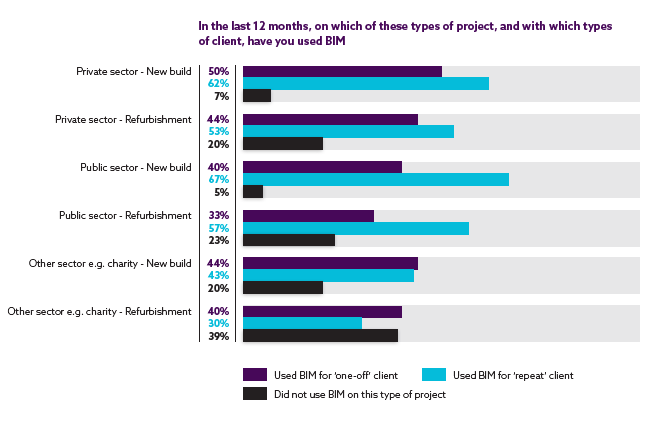
While the Government BIM mandate initially drove adoption in public sector projects, BIM is currently used more on private projects (77%) rather than public ones (62%).
Going digital
Over the past decade, manufacturers have increasingly provided information as digital objects. These are pre-drawn representations of building products which can be dropped into the design model. Currently 81% of respondents said they needed these objects to work effectively, an increase of 12% from last year, reflecting the growing demand for digital product data from manufacturers.
Commenting on the findings, David Bain, Research Manager said “The growth in people using BIM is hard to dispute. For many projects, it’s as much part of the construction process as bricks and mortar. BIM users say their businesses are more profitable and productive. Clients are reaping the rewards of having better maintained and more efficiently run buildings. The industry is working differently to a decade ago and benefiting from international standards, with cross-industry organisations providing advice and training.”
Richard Waterhouse, Chief Strategy Officer, NBS, comments, “Construction is now digitising at pace, yet there are still gaps that need plugging. Clients have a big role in driving BIM use, the data proves they benefit from BIM throughout a building’s life. As a sector, we need to work together to dispel the prevailing myth there are projects too small for BIM. All types of construction benefit from BIM, we have to help smaller players unlock the benefits.”
Waterhouse adds, “There’s also a pool of manufacturers who are missing out. Specifiers want a range of technical information including digital objects. Make their lives easier and the manufacturers will benefit too.”
About the survey
NBS carried out the survey online between December 2019 and March 2020. We received responses from 1061 construction professionals. All organization sizes were represented, from micro-practices of one or two people to large practices with over 500 staff. As previously, responses came primarily from the design community, with 27% being architects. Engineers were also well represented. Over a quarter were architectural technologists or BIM managers. However, other members of the project team also participated, including: contractors, project managers, cost consultants, manufacturers, surveyors and clients.
Respondents came from across the UK, and almost a quarter were working outside of the country.