
Paroc®: Why Precision Is Everything For Insulation Specification

Paroc®: Why Precision Is Everything For Insulation Specification

Jun 2, 2025 |NBS |2 Minute Read

Take a deep dive into the importance of precision when specifying insulation with this spotlight on leading insulation manufacturer, Paroc®.

2 June 2025

Technical insulation must be specified with precision and accuracy. Insulation manufacturer and NBS partner Paroc®, part of Owens Corning, has released a UK thickness guide that helps specifiers choose the correct insulation thickness every time. In this NBS spotlight, we explore how Paroc® is assisting specifiers to make more accurate technical decisions…

Specifiers must carefully consider insulation thickness at the design phase. If the wrong thickness is chosen, an installer may have to remove and reinstall pipework, often at a significant cost and inconvenience. Even minor deviations in insulation thickness can compromise an entire system, so it’s absolutely crucial that you get it right from the start.

The decisions about technical insulation systems will impact energy efficiency, compliance and long-term performance. Mistakes or even accidental oversights can lead to significant delays and soaring expenses, which is why both specifiers and installers need a reliable and effective way to make more consistent technical decisions.

Recognising this, Paroc® has developed a comprehensive UK Thickness Guide, a reliable resource that helps specifiers choose the right insulation thickness for every project.
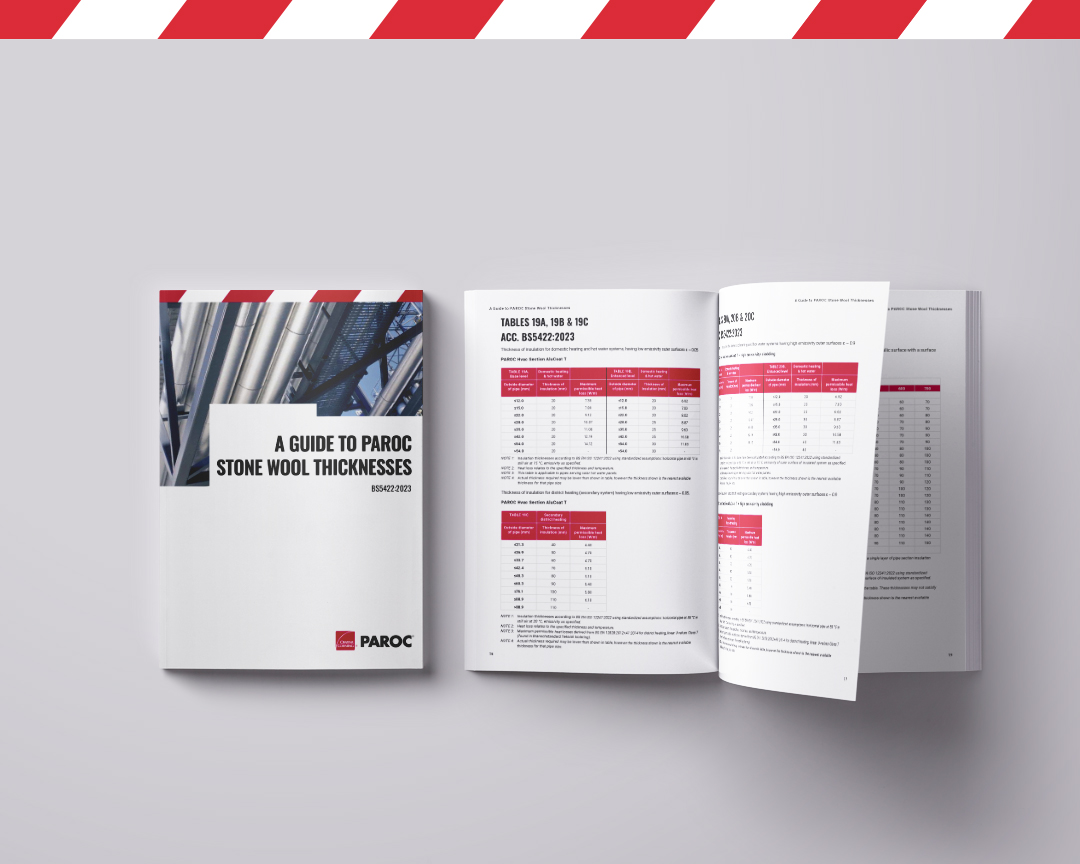
paroc-mockup
Download now

Choosing the right thickness with Paroc Stonewool insulation

Installers and specifiers can turn to Paroc® insulation to meet high technical standards. Paroc®’s stonewool insulation offers outstanding thermal performance, high durability, and fire resistance. The brand remains committed to consistent product quality and full compliance with updated specifications.

In addition to the UK Thickness Guide, Paroc® also offers a free thickness calculation tool, Calculus, which is updated to the latest calculation standard ISO 12241:2002.

Staying up to date with BS5422:2023

The update to BS5422:2023 replaces the 2009 version, bringing key changes around specification and improving efficiency. Pipe sizes are listed using a “less than or equal to” system, which reduces the need for interpolation and helps enhance the overall thermal efficiency of a project. The updated standard now also carries tables that provide additional clarity for specifiers. Paroc®’s product range allows specifiers to remain current with the latest standards.

Additionally, now that the BIM-aided design of HVAC installation is the standard for professional specifiers in Europe, Paroc® has introduced a tool that enables the intelligent, fully automated selection of insulation solutions for projects that are fully compliant with BS 5422. Click here to learn more.

paroc-download
Download now

Specify with precision with Paroc® and NBS

The importance of specifying the correct thickness relies on working with suppliers that you can trust. Work with Paroc® to guarantee reliable, high-quality insulation for every project to avoid installation errors and achieve peak performance.

There’s no room for error. Use Paroc’s UK Thickness guide to ensure every specification is as precise as possible. Browse and specify Paroc® products using NBS Source, or visit this page to view HVAC solutions.


View Paroc's range in NBS Source

Our latest news

Visqueen supports one of the first Gateway 2 approvals under the Building Safety Act

The Dyecoats development in Leeds marks a major milestone for the UK housing sector. The £100 million flagship Latimer Homes scheme being delivered by GRAHAM is one of the first high-rise new-build projects in the country to achieve Building Safety Act Gateway 2 approval, a crucial pre-construction sign-off confirming that the design meets all safety and regulatory requirements before work begins on site.

Building Safety ActSponsored

Five questions to ask when specifying insulated panels

Selecting an insulated panel system for an industrial building should start with the building and application requirements.

Design and SpecificationSponsored

NBS and BDP join forces to improve generic carbon data in construction

Today, NBS (part of Hubexo), the platform for connected construction information, announces a long-term strategic partnership with BDP, a major global multidisciplinary practice of architects, designers, engineers and urbanists. The partnership recognises BDP's integral role in the development of NBS LCA, a new life-cycle carbon assessment platform providing professionals with high-quality, reliable and easy-to-use carbon data to ensure accurate tracking as construction projects evolve. BDP's primary contribution to NBS LCA has been the development of more than 1,300 pre-calculated generic assemblies, covering the most commonly used building fabric elements alongside key concrete and steel structural elements. These assemblies provide whole-element carbon data, giving designers consistent, UK-relevant carbon benchmarks from the earliest stages of project design. Users can easily and instantly apply carbon rates to a range of pre-configured common building elements, including walls, floors, and roofs. Developed by BDP and NBS, the assemblies remove the need for designers to manually build up material layers or calculate individual components at the concept stage. This saves significant time and effort, enabling proportionate and responsible carbon evaluation early in the design process, when decisions have the greatest impact on a project's overall carbon footprint. BDP also participated in collaborative workshops that directly informed the development of NBS LCA, helping to shape a tool that is practical, accessible and aligned with real-world UK construction workflows. Dr Lee Jones, Head of Sustainability at Hubexo, said: “BDP's contribution to NBS LCA has been invaluable. Their depth of project experience and technical knowledge has directly shaped the generic assemblies at the heart of the platform. These assemblies give designers a reliable, UK-relevant starting point for carbon assessment, without the burden of building everything from scratch. This is exactly the kind of collaboration that moves the industry forward, and we're proud to be working with BDP on a long-term basis.” Julia Yao, Associate, Sustainability Consultant at BDP, said: “Carbon assessment needs to be embedded in design from day one, not bolted on at the end. Working with NBS to develop its LCA product has been a genuine opportunity to put that principle into practice. The generic assemblies we developed draw on real project data and are designed to give designers meaningful, actionable carbon information at the concept stage. We're delighted to see them at the core of a platform that will be used across the industry.” With the UK Government outlining its commitment to responsible carbon reporting through its Carbon Budget and Growth Delivery Plan, professionals need reliable, easy-to-use tools to assess and report embodied carbon. NBS LCA addresses this need by integrating carbon calculations with live design work, drawing on structured data from Circular Ecology's ICE Database and more than 12,500 verified, specification-ready construction products with Environmental Product Declarations (EPDs) from NBS Source and ECO Portal. Over the coming months, NBS and BDP will continue to develop their partnership, with a shared commitment to improving the quality and accessibility of carbon data for construction professionals across the UK. NBS LCA is available now, with flexible subscriptions designed for all professionals. For more information, visit the website here.

Product update