
NBS releases findings from its annual Digital Construction Survey

NBS releases findings from its annual Digital Construction Survey

Oct 19, 2021 |NBS |4 Minute Read
  • 80% of respondents think adoption of digital technologies is delivering a better built environment, with three quarters (75%) saying it improves sustainability.
  • The survey reveals construction technologies, including BIM adoption and cloud computing, will transform the built environment for the better over the next five years.
  • Although the majority believe digital working and BIM adoption will be essential to realise the Golden Thread, only one in two (51%) are clear how they will do this.
  • A significant proportion (58%) of the sector expect to split their time between home and office/factory/site over the next five years.

Today NBS, the platform for connected construction information, has revealed its eleventh annual survey, now the Digital Construction Survey, previously the NBS BIM Survey. With over nine hundred respondents, this year’s report provides a more comprehensive picture of the sector’s digital transformation, along with BIM adoption levels, and day-to-day usage of technology.

Importance of digital

With approaching three-quarters (71%) of respondents now using BIM, it’s fair to consider this approach now embedded across the sector, with adoption levels consistent for the past couple of years.

The construction industry is now on board with technology and confident that it will help solve the challenges facing the sector, as demonstrated by eight in ten stating that digital technologies deliver a better-built environment, with three quarters (75%) saying that tech offers sustainability benefits.

NBS_digital_construction_report-01

The Golden Thread

The forthcoming Building Safety Bill has forced safety to the forefront of the construction industry, and regulation requires a digital “golden thread” of information. This is an accurate, up-to-date digital record of all data required to maintain and operate a building. This includes how it was designed, built, and any maintenance. This log records all the processes, construction products used, and the decisions made in construction and operation.

The golden thread covers information and documents as well as information management processes, all stored as structured digital information. While eight in ten (78%) respondents say they need to be working digitally and 70% say they need to have adopted BIM to make the golden thread a reality, only half (51%) are clear how they will do this.

The golden thread process is made much easier with the data available through a digital twin. In addition, having a digital twin enables access to all of the essential information in one place and allows for constant monitoring and maintenance of the asset.

NBS_digital_construction_report-02

While eight in ten (78%) respondents say they need to be working digitally and 70% say they need to have adopted BIM to make the golden thread a reality, only half (51%) are clear how they will do this.

The golden thread process is made much easier with the data available through a digital twin. In addition, having a digital twin enables access to all of the essential information in one place and allows for constant monitoring and maintenance of the asset.

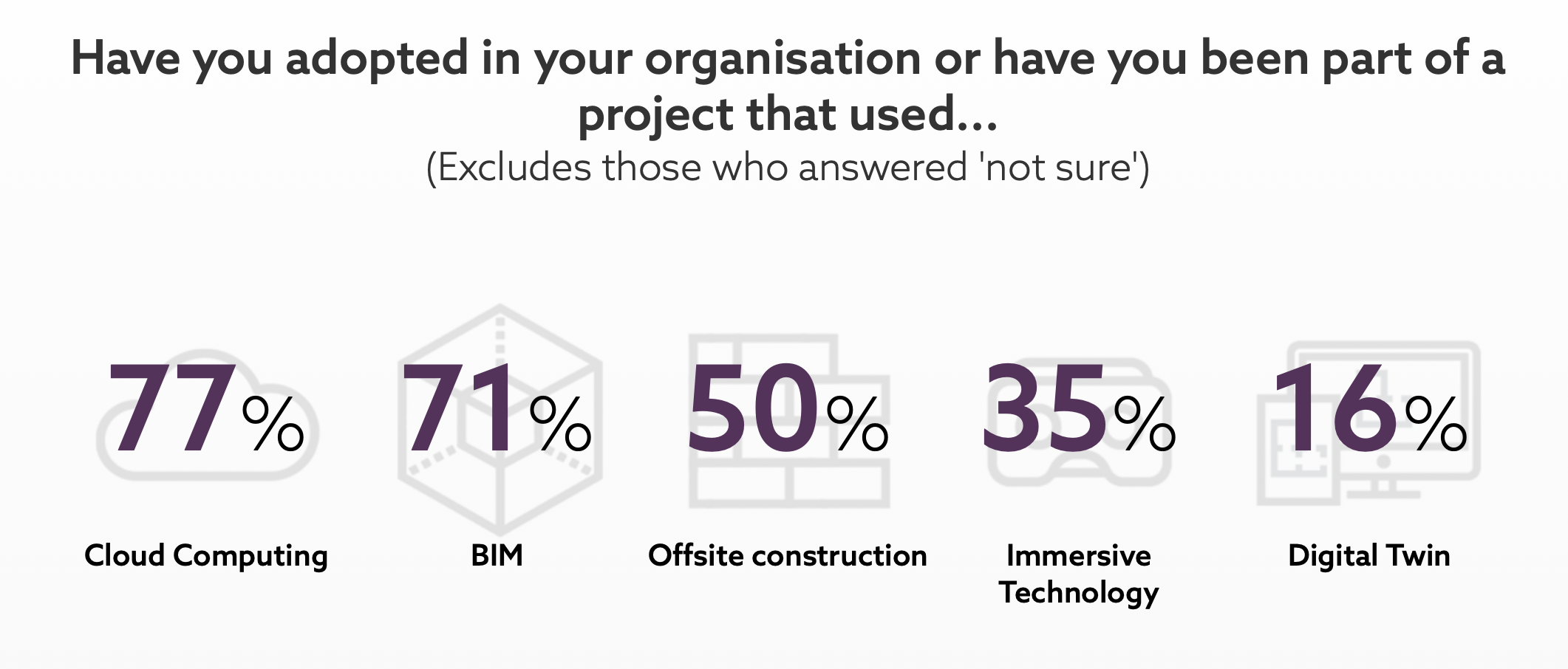
While three quarters (74%) of respondents believe that digital technology is helping create a safer built environment, digital twin adoption is still relatively slow, with only 16% having worked on a project that used a digital twin in the past year.

New Tech

In the past twelve months, half the survey's respondents have worked on an off-site project, a clear sign that a move to MMC is taking place, yet this figure shows there's still work to be done if the government is going to embrace MMC on the scale it intends.

Over a third (35%) already use immersive techs such as VR/AR, and a half (50%) plan to within five years. These figures could indicate that a switch to digital technologies that can improve data collection and analysis and safety is becoming the norm as construction sites continue to become digital tech 'hotspots.'

The survey also reveals that over three-quarters of the industry (77%) use cloud computing. This result is higher than previous year, compared to 42% in 2020. A clear sign that digital methods are being fully embraced and that steps towards the Golden Thread are now coming into effect, providing a clear digital footprint.
NBS_digital_construction_report-04

Transformative technology

The construction industry has traditionally lagged behind others in the adoption of digital capabilities. The Digital Construction Survey asked respondents to rank how various essential technologies or ways of working will transform the sector for the better over the next five years.

The top five are as follows, 1) BIM, 2) Cloud computing, 3) Offsite construction, 4) Digital Twins, 5) AR/VR mixed reality.

NBS_digital_construction_report-03

Commenting on the survey’s results, David Bain, NBS’ Research Manager, said, “The adoption of new, digital technologies and ways of working should help to improve outcomes, so it is encouraging that 80% of built environment professionals agree that they are helping to create better buildings and places. Also, 75% say these innovations positively impact environmental sustainability, and 74% see them making a safer built environment. The industry also recognises the key role digital and BIM will play in realising the golden thread of information.

The use of cloud computing and blended working has become commonplace, but BIM has the most significant potential to transform the built environment for the better. BIM is now part of many people’s way of working (71%), with almost two-thirds of these recognising it as being about better information management, not just software. However, there remain challenges in taking the benefits of BIM and digital to all parts of the industry.”

Over nine hundred construction professionals took part in this year’s Digital Construction Survey, which included views from architects/engineers and other consultants (66%), contractors (13%), clients (9%), and suppliers (9%) in the UK and beyond.

Click here to access the full report

Our latest news

NBS and BDP join forces to improve generic carbon data in construction

Today, NBS (part of Hubexo), the platform for connected construction information, announces a long-term strategic partnership with BDP, a major global multidisciplinary practice of architects, designers, engineers and urbanists. The partnership recognises BDP's integral role in the development of NBS LCA, a new life-cycle carbon assessment platform providing professionals with high-quality, reliable and easy-to-use carbon data to ensure accurate tracking as construction projects evolve. BDP's primary contribution to NBS LCA has been the development of more than 1,300 pre-calculated generic assemblies, covering the most commonly used building fabric elements alongside key concrete and steel structural elements. These assemblies provide whole-element carbon data, giving designers consistent, UK-relevant carbon benchmarks from the earliest stages of project design. Users can easily and instantly apply carbon rates to a range of pre-configured common building elements, including walls, floors, and roofs. Developed by BDP and NBS, the assemblies remove the need for designers to manually build up material layers or calculate individual components at the concept stage. This saves significant time and effort, enabling proportionate and responsible carbon evaluation early in the design process, when decisions have the greatest impact on a project's overall carbon footprint. BDP also participated in collaborative workshops that directly informed the development of NBS LCA, helping to shape a tool that is practical, accessible and aligned with real-world UK construction workflows. Dr Lee Jones, Head of Sustainability at Hubexo, said: “BDP's contribution to NBS LCA has been invaluable. Their depth of project experience and technical knowledge has directly shaped the generic assemblies at the heart of the platform. These assemblies give designers a reliable, UK-relevant starting point for carbon assessment, without the burden of building everything from scratch. This is exactly the kind of collaboration that moves the industry forward, and we're proud to be working with BDP on a long-term basis.” Julia Yao, Associate, Sustainability Consultant at BDP, said: “Carbon assessment needs to be embedded in design from day one, not bolted on at the end. Working with NBS to develop its LCA product has been a genuine opportunity to put that principle into practice. The generic assemblies we developed draw on real project data and are designed to give designers meaningful, actionable carbon information at the concept stage. We're delighted to see them at the core of a platform that will be used across the industry.” With the UK Government outlining its commitment to responsible carbon reporting through its Carbon Budget and Growth Delivery Plan, professionals need reliable, easy-to-use tools to assess and report embodied carbon. NBS LCA addresses this need by integrating carbon calculations with live design work, drawing on structured data from Circular Ecology's ICE Database and more than 12,500 verified, specification-ready construction products with Environmental Product Declarations (EPDs) from NBS Source and ECO Portal. Over the coming months, NBS and BDP will continue to develop their partnership, with a shared commitment to improving the quality and accessibility of carbon data for construction professionals across the UK. NBS LCA is available now, with flexible subscriptions designed for all professionals. For more information, visit the website here.

Product update

Bourne Amenity NBS case study: Finsbury Circus Gardens

Bourne Amenity recently supported the restoration of London’s Finsbury Circus Gardens by supplying specialist soils, bark and materials for the soft landscaping works, providing the right foundation for the new planting and lawn areas.

Product update

Hubexo UKI achieves independently verified carbon neutrality

Hubexo UKI achieves independently verified carbon neutrality for 2025 against ISO 14068-1:2023 Independent verification returns a 0% QA variance rate Emissions intensity reduced from 13.14 to 11.65 tCO₂e per £m revenue year on year Achievement supported by energy efficiency measures, renewable energy provision, improved supply chain measures, and long-term net zero targets Local bio-diversity gains supported through local afforestation projects Hubexo UKI, incorporating NBS, Glenigan and CIS Ireland, has been awarded Carbon Neutral status for the fourth consecutive year, independently verified against the internationally recognised ISO 14068-1:2023 standard for Carbon Neutrality. This achievement reflects not only the accuracy and transparency of the carbon reporting by Hubexo UKI, but also its commitment to meaningful emissions reduction and long-term decarbonisation. The carbon neutrality verification covers all UK operations for 2025 across Scope 1, 2 and material Scope 3 emissions. The third-party assessors conducted a two-stage verification process, returning a 0% QA variance rate, confirming a high-level of data integrity, supported by robust, auditable evidence. Delivering Carbon Neutrality and Beyond Following verification of its emissions inventory, Hubexo retired 896 tonnes of CO₂e through independently verified Gold Standard carbon credits linked to renewable energy projects. The achievement extends beyond offsetting alone and is underpinned by operational changes. With the future in mind, NBS relocated its Newcastle headquarters to a modern BREEAM excellent-rated, fully electric office powered by 100% renewable electricity, projected to save approximately 60 tonnes of carbon per year, with the carbon reduction benefits of this switch being enabled from 2026 onwards. These actions support Hubexo's broader objective of reducing emissions at source and lowering reliance on offsetting over time. Although the business grew during the reporting period, emissions intensity fell from 13.14 tCO₂e per £m revenue in 2024 to 11.65 tCO₂e per £m revenue in 2025, an indicator that carbon emissions are becoming decoupled from business growth. Alongside verified offsetting activities, Hubexo has funded planting 800 native UK trees local to its offices through environmental partner Carma Earth. The initiative supports biodiversity enhancement, community green spaces and programmes that help military veterans access nature-based therapy and employment pathways. Building Towards Net Zero This milestone sits within a broader decarbonisation journey. Hubexo operates within a group-wide climate framework with targets to reduce emissions by 50% by 2030 and reach Net Zero by 2045, in line with the Science Based Targets initiative (SBTi) for the IT and software sector. Plans for 2026 include eliminating fossil fuel heating, deepening supplier engagement through new ESG technology and transitioning supply chain reporting from spend-based to activity-based methodologies. Dr Lee Jones, Head of Sustainability, Hubexo UKI said: "Achieving independently verified carbon neutrality under ISO 14068 reflects our commitment to transparency, accountability and climate action, and whilst we acknowledge that this is merely a stepping stone to our long-term commitments, it gives our customers, partners and colleagues confidence that our environmental claims are backed by solid data and independent scrutiny. “Sustainability is about more than carbon accounting alone. We're reducing emissions at source, investing in our communities and working toward a clear net zero pathway. Together, we're building a more sustainable future for the construction sector, and that's something the whole team can be proud of.” Joanne Keit, Hubexo UKI President, added: “Building a sustainable future is at the heart of Hubexo’s mission. We are committed to driving innovation and empowering our customers to create a better, more sustainable world. That’s why we are delighted to have achieved carbon neutrality once again. This recognition reflects our ongoing commitment to sustainability and reducing our environmental impact. Our customers can be confident that we continue to take meaningful action to operate more responsibly and support a greener future. “Not only have we maintained carbon neutrality for the fourth year, but during our largest-ever UK hub relocation, we also successfully reduced our overall emissions. This is a significant collective achievement, and one that we are incredibly proud of.”

Sustainability