Highlights
- Only a third of construction professionals achieve sustainability targets – whilst a further third ‘rarely achieve’ them
- Fewer people report achieving sustainability targets on projects compared with 2014
- In the past year, just 14% have seen sustainability goals set on every project
- Only 4% have worked exclusively on net-zero projects, whilst more than a half haven’t worked on a single net-zero project (in the past year)
- Lack of client demand and the cost of achieving sustainability stated as main barriers to sustainability success
Today, NBS, a leading specification and product information platform for the construction industry, reveals the findings of its ‘Sustainable Futures Survey’, a study aimed at understanding sustainability attitudes and protocols within the construction sector.
The research found that, despite motivation from most construction professionals to deliver sustainable outcomes – only a third usually manage to achieve it within a project. Worrying still, was that a further third of respondents ‘rarely achieved’ sustainability goals and 1 in 10 never achieve them at all.
The study, which polled 608 construction professionals, found that less people are achieving sustainability targets on projects, compared to those in its 2014 Sustainability Report.
Sustainability setting
Respondents were also quizzed on the the number of projects that had received clear sustainability targets within the past year. Promisingly, 69% had worked on projects where sustainability goals had been included at least some of the time, whilst a quarter (25%), had seen targets ‘most of the time’. However, just 14% had seen targets set on every build, showing a need for improvement when goal-setting at the start of each project.
With the government’s 2050 Net Zero targets in-sight, currently, just 4% of respondents have worked on exclusively net-zero projects and over half (51%) had not worked on a single net-zero project in the past year. Interestingly, those who are more confident on the topic of sustainability are also more likely to include sustainability goals within their own builds – as well as work on net-zero projects.
Breaking the barriers
As part of the study, NBS also wanted to explore some of the barriers to achieving sustainability to find out how standards can be improved.
When identifying the main barriers to success, over half stated that a lack of client demand (52%) was the most common cause – just 1% more than the cost of achieving sustainability (51%). Another concern was the view that sustainable products are being ‘value engineered’ (38%), suggesting cost-cutting measures could rise question marks over quality. 37% also stated that lack of government policy and regulation was another reason for a lack of take up of sustainable practices, highlighting the impact government intervention could have on the hearts and minds of those working in the sector.
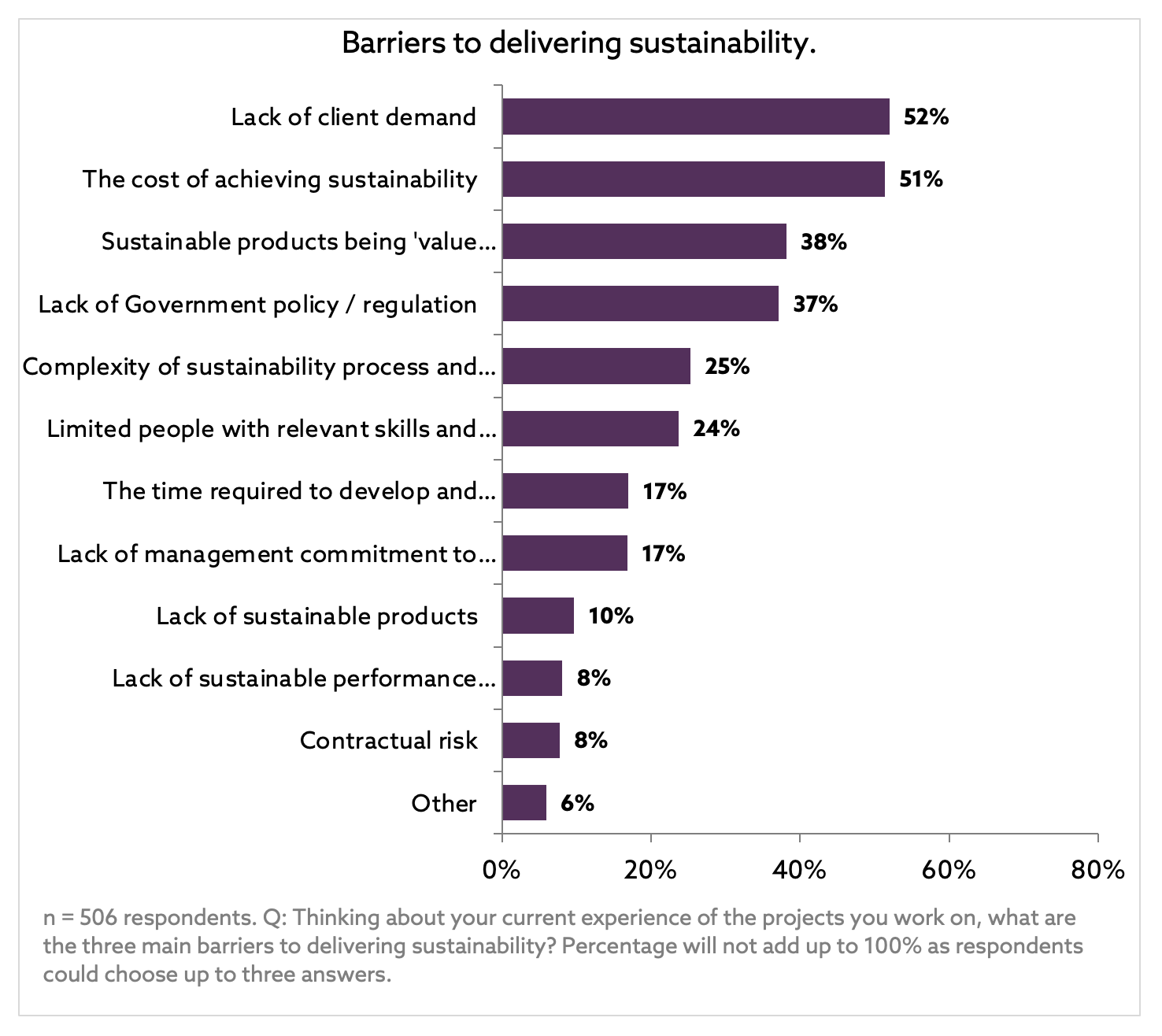
Interestingly, there were some differences of opinion when it came to responsibility and project roles, depending on the audience in question.
For contractors, contractual risks were a main barrier to achieving sustainability. Given the on-going issues with supply chains and squeezed profit margins, it’s clear that contractors remain cautious when it comes to needing additional products which could cause projects to overrun.
From a supplier standpoint, they are more likely to view sustainable products as being ‘value-engineered’, suggesting there is a risk that products may be value engineered out and perhaps showing a need for further education with client and contractor stakeholders.
However, for clients, a lack of management commitment and a lack of sustainable performance information were marked as a major barrier – showing a further push from project designers and specifiers could increase the chances of sustainability being achieved on a build.
Personal responsibility
But how do these stats fair in terms of personal perceptions and beliefs around sustainable construction? NBS’ ‘Sustainable Futures’ report also looked at individual responsibility as well as how the subject of sustainability is perceived from within organisations.
From the 608 construction professionals who took part in the survey, nearly all (97%) said that sustainability is either important or quite important to them personally. The topic also appears to resonate with their executive/leaderships with 81% placing it as either important or quite important. The same is seen with the organisations they work for as a whole (85%), revealing a strong appetite for more sustainable outcomes across the board.
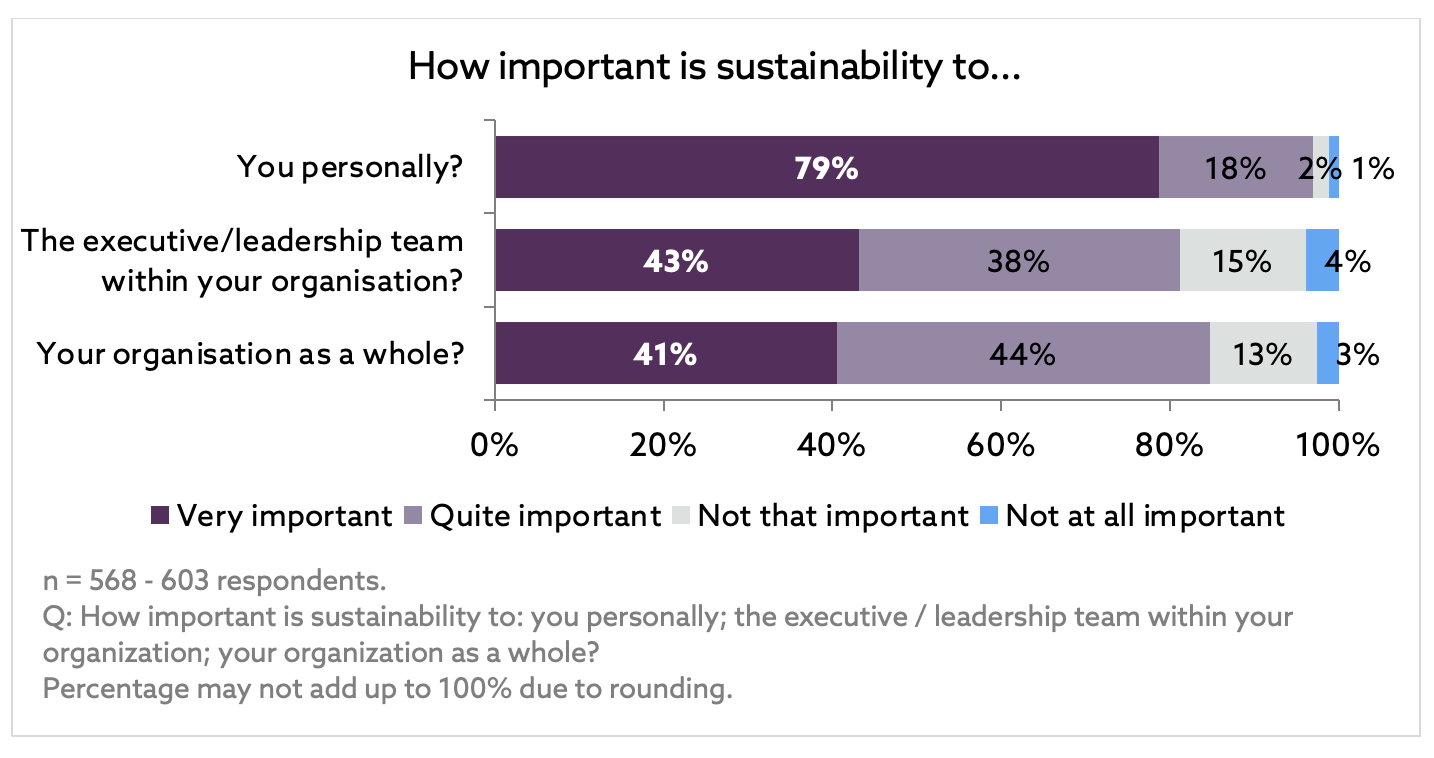
Diving deeper still, when asked why they personally think about sustainability in projects, 87% put that their own personal beliefs and values played a key part in the decision making. Over half (53%) also stated that they like to lead by example. Again, compared to NBS’ 2014 Sustainability Report, it’s clear that views and behaviour relating to sustainability within construction are changing – becoming increasingly led by personal opinion and values and less so because of legislation and the beliefs of others.
What’s clear is that a lack of legislative direction from the government on the area of sustainability may be generating a stronger feeling of personal responsibility from construction professionals. For example, the removal of initiatives such as the ‘Code for Sustainable Homes’ could be seen as a lack of commitment towards sustainable outcomes. However, the recent announcement around this year’s spring budget that VAT on energy saving materials will be cut to 0% could be a sign of a new found enthusiasm from the government.
The report also captured thoughts and feelings as to what the next big thing in sustainable architecture could be. Many spontaneously referred to the need for a circular economy and that more time should be spent recycling and reusing existing building stock, rather than building new each time.
One respondent said: “hopefully more retrofitting instead of new build, less demolition of existing buildings, better sustainable active travel infrastructure for new and existing housing and less building on green land and green belts.”
Another said: “Lifecycle consideration – an increase in the planning for demolition and refurbishment of a building and designing a fabric which can be easily taken apart and reused and recycled.”
Also mentioned was the development of sustainable products and technology, using newer material which is lower in carbon or produces less emissions, as well as materials that are easier to deconstruct at the end of its lifecycle. However, it was noted that these materials needed to be economically viable for them to be specified and used.
Speaking on the findings of the report, Lee Jones, head of manufacturer solutions at NBS and acting head of sustainability at Byggfakta Group, said: “At NBS, sustainability is a high priority for us and we recognise the role construction plays in tackling the global issue of climate change.
“The findings are eye opening – it’s clear that projects need to have clearer guidelines on sustainability goal setting, implementing targets up front during the design phases will help encourage lower carbon outcomes. A further uptake of digital construction will help architects and specifiers ‘design in’ these measures.
“There’s also a need for greater communication and trust between all parties in terms of specific responsibilities. Uncertainty around who is accountable for what is allowing sustainability standards to slip. Further work is needed on behalf of product manufacturers when it comes to providing sustainability information for their products – that way green credentials can be compared and understood.
“It’s promising that individuals are now taking on more personable responsibility to deliver more environmentally friendly results – and we’ve seen how further education and knowledge on the topic goes hand in hand with sustainability success.
“Moving forward, it’s clear the industry needs further guidance and commitment from the UK government around sustainable legislation and that we need to prioritise a circular economy, thinking more about recycling and reuse of existing buildings. Given how much we’ve learnt from this year’s study, it will be fascinating to see how far the needle has moved in our next sustainability report.”
Jenny Archer, Senior Research Executive, NBS who led this project, said: “It’s been a while since we took a deep dive into the industry’s experiences around sustainability and given the recent economic and environmental situation, these results have come at a good time.
“It’s important to get a real understanding of how seriously sustainability is being taken within construction – once we identify the barriers to progress, we can start finding solutions. At NBS, this is our speciality – the findings from this report are extensive and will help us tailor our content to improve knowledge and education around sustainability in the coming months.”
To find out more, access to the full report can be found here.