North East tech firms come together to stoke BIM dynamo

North East tech firms come together to stoke BIM dynamo

Feb 16, 2017 |Richard McPartland |2 Minute Read

The North East's tech community has come together to share ideas on how to nurture the opportunities afforded by digital construction both within and on behalf of the region.

At NBS we've long sang the praises of the North East region's credentials when it comes to BIM but how do you galvanise an entire region around a shared vision to reap the fullest rewards?

Think TankThat's exactly the question that was on the table as Dynamo North East - a membership body aimed at building the region's enterprise IT cluster - held a special Think Tank event at NBS's head office this lunchtime.

Paul Swaddle, Head of Business Solutions at NBS, welcomed delegates to the newly-refurbished Old Post Office on St Nicholas Street and invited attendees to set out and explore a co-ordinated regional approach to capitalising on the benefits of BIM.

Getting down into the detail over a buffet lunch participants wrestled with topics that will doubtless be familiar to construction professionals regardless of geography.
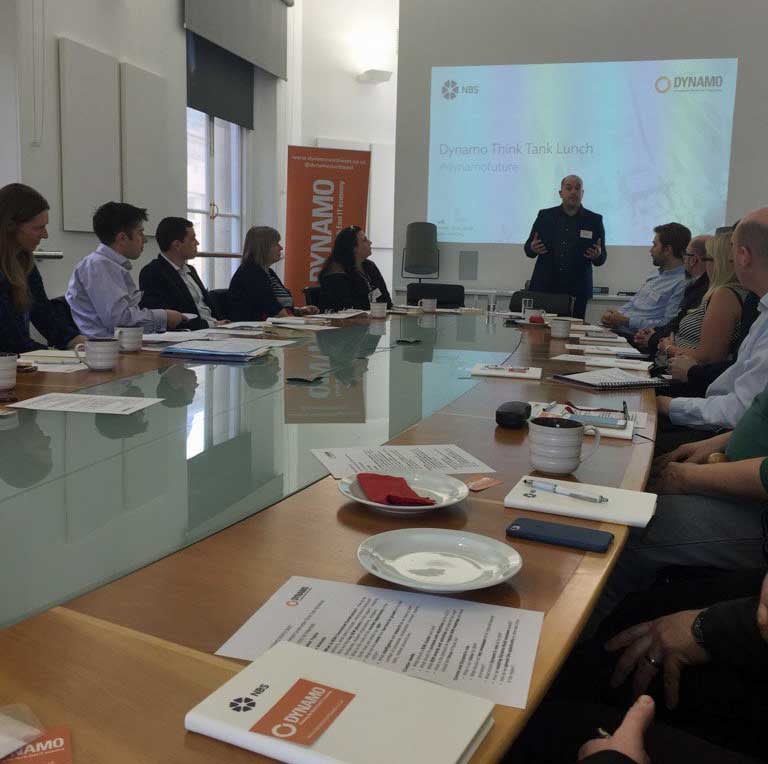
Delegates at the Dynamo North East Think Tank event

What is BIM? Is the term still useful or do the emerging terms of connected construction or digital construction now prove more helpful when looking to engage?

Citing a decline in the number of Google searches for 'BIM' and a widening of focus under Digital Built Britain, many argued that BIM was increasingly only part of much wider connected, digital revolution. A revolution that should be considered and embedded across the construction lifecycle and not siloed within a particular project or organisation.

Who are the key players? How do we document the organisations making an impact already and those who have most to gain? How can we come together and make the most of our strengths?

Education sector, businesses, member groups, funding organisations and clients all form part of a vast ecosystem. Getting whole-life benefits post-construction through engaging FM professionals and building managers is key to reaping rewards. Do we need a 'Tube-style map' of the key players to raise awareness?

How do you galvanise an entire region around a shared vision to reap the fullest rewards?

What are the needs and barriers for growth of the BIM sector?

Participants agreed that showing real commercial return on investment when following a BIM process is often difficult. How can we ensure value is captured and tracked from the start and used to espouse the values of such an approach to others? The need for case study-style material, template docs and exemplar projects was seen to be useful. Providing a toolkit to help those at the bottom of organisations inform those at the top (and vice versa) was thought useful by some.

What is the scale of the opportunity? What do we know already and what should we know through intelligence and research?

In a global economy the opportunity transcends regional and even country boundaries. There's significant potential to deliver in areas where construction projects are plentiful - for example, the South East and North West, and opportunities to in those countries that broadly follow British approaches, regulations and standards.

Much then to think about for Dynamo as it starts the process of articulating a shared vision that will help the North East's approach and assets be clearly understood within the region and much further afield.

A report collating participant feedback from the Think Tank event is now available on the Dynamo North East website.

NBS run a comprehensive programme of events throughout the year. You can keep up-to-date with what's in store at www.theNBS.com/nbsevents.

Our latest news

Visqueen supports one of the first Gateway 2 approvals under the Building Safety Act

The Dyecoats development in Leeds marks a major milestone for the UK housing sector. The £100 million flagship Latimer Homes scheme being delivered by GRAHAM is one of the first high-rise new-build projects in the country to achieve Building Safety Act Gateway 2 approval, a crucial pre-construction sign-off confirming that the design meets all safety and regulatory requirements before work begins on site.

Building Safety ActSponsored

Five questions to ask when specifying insulated panels

Selecting an insulated panel system for an industrial building should start with the building and application requirements.

Design and SpecificationSponsored

NBS and BDP join forces to improve generic carbon data in construction

Today, NBS (part of Hubexo), the platform for connected construction information, announces a long-term strategic partnership with BDP, a major global multidisciplinary practice of architects, designers, engineers and urbanists. The partnership recognises BDP's integral role in the development of NBS LCA, a new life-cycle carbon assessment platform providing professionals with high-quality, reliable and easy-to-use carbon data to ensure accurate tracking as construction projects evolve. BDP's primary contribution to NBS LCA has been the development of more than 1,300 pre-calculated generic assemblies, covering the most commonly used building fabric elements alongside key concrete and steel structural elements. These assemblies provide whole-element carbon data, giving designers consistent, UK-relevant carbon benchmarks from the earliest stages of project design. Users can easily and instantly apply carbon rates to a range of pre-configured common building elements, including walls, floors, and roofs. Developed by BDP and NBS, the assemblies remove the need for designers to manually build up material layers or calculate individual components at the concept stage. This saves significant time and effort, enabling proportionate and responsible carbon evaluation early in the design process, when decisions have the greatest impact on a project's overall carbon footprint. BDP also participated in collaborative workshops that directly informed the development of NBS LCA, helping to shape a tool that is practical, accessible and aligned with real-world UK construction workflows. Dr Lee Jones, Head of Sustainability at Hubexo, said: “BDP's contribution to NBS LCA has been invaluable. Their depth of project experience and technical knowledge has directly shaped the generic assemblies at the heart of the platform. These assemblies give designers a reliable, UK-relevant starting point for carbon assessment, without the burden of building everything from scratch. This is exactly the kind of collaboration that moves the industry forward, and we're proud to be working with BDP on a long-term basis.” Julia Yao, Associate, Sustainability Consultant at BDP, said: “Carbon assessment needs to be embedded in design from day one, not bolted on at the end. Working with NBS to develop its LCA product has been a genuine opportunity to put that principle into practice. The generic assemblies we developed draw on real project data and are designed to give designers meaningful, actionable carbon information at the concept stage. We're delighted to see them at the core of a platform that will be used across the industry.” With the UK Government outlining its commitment to responsible carbon reporting through its Carbon Budget and Growth Delivery Plan, professionals need reliable, easy-to-use tools to assess and report embodied carbon. NBS LCA addresses this need by integrating carbon calculations with live design work, drawing on structured data from Circular Ecology's ICE Database and more than 12,500 verified, specification-ready construction products with Environmental Product Declarations (EPDs) from NBS Source and ECO Portal. Over the coming months, NBS and BDP will continue to develop their partnership, with a shared commitment to improving the quality and accessibility of carbon data for construction professionals across the UK. NBS LCA is available now, with flexible subscriptions designed for all professionals. For more information, visit the website here.

Product update