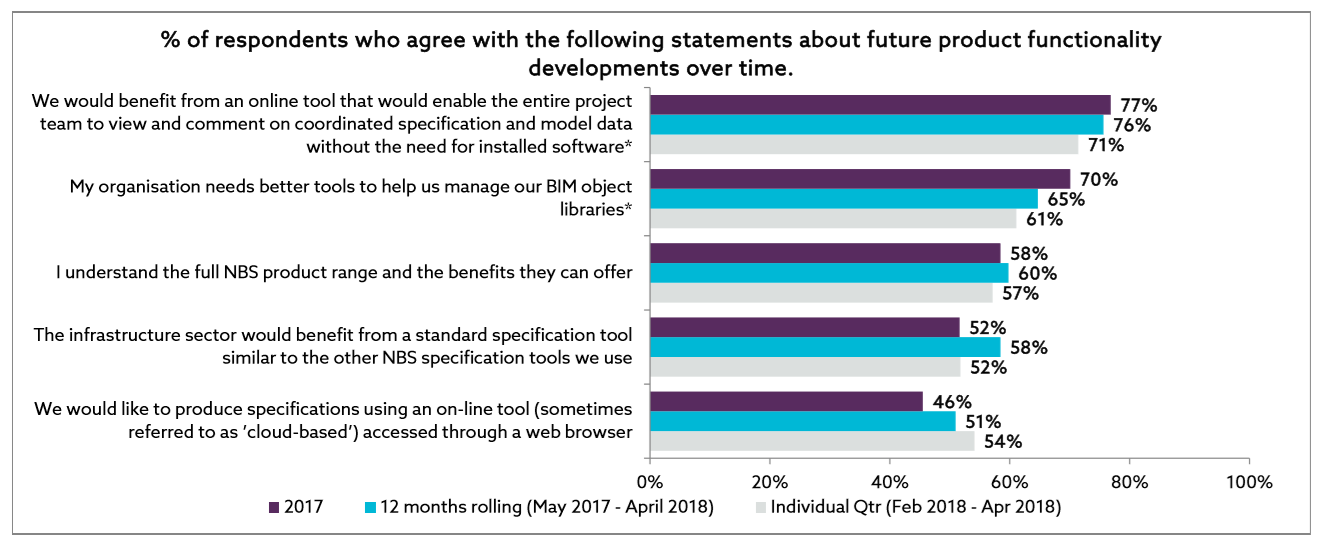
Our customers drive the NBS Product developments in many ways: from customer satisfaction surveys, advisory panels to our agile Innovation process. A recent NBS Customer Satisfaction Survey had the following results for Future Direction:
Since our news in 2017 about expansion into Canada and Australia, we’ve worked closely with a select group of large scale global practices to understand the growing digital needs and requirements of the built community. We have been exploring themes from the NBS Customer Satisfaction Survey such as an online specification platform along with how they specify globally.
Our innovation panel experience has provided opportunities for us to explore, test and develop new and advanced features for a new collaborative specification platform with the industry expertise of our panel guiding the development of the platforms functionality.
Throughout this process we wanted to understand how participating practices felt about working with us on this journey of innovation and development. Here’s what they had to tell us:
The ability to work within a cloud-based software platform allows Mott MacDonald to collaborate with external organisations undertaking projects worldwide using the capabilities of the collaborative software.
Mark Bragg, Principal Mechanical Engineer, Mott MacDonald
 |
"Overall, our involvement with the NBS team led to good collaboration, with each step of the development process well-explained with clear objectives and with informed progress for the NBS Chorus product. Efficiencies will be achieved by streamlining specification production across Mott MacDonald worldwide, leading to processes which improve BIM collaboration and reliability of information, with reduced production time and resource requirement. Reduced risk may only be achieved by ensuring the Chorus software maintains both its reliability and update process to ensure information is both technically accurate and up-to-date, reducing our risk to our clients and to Mott MacDonald when undertaking major construction projects." |
This platform will not only allow us to work more effectively between studios but also with other consultants. The ability to review specifications not in isolation from the design/model but as part of the whole design process will allow for more collaborative discussion.
Nick Ainscough, BIM Development Lead, IBI Group
|
"From our perspective it’s not just a time cost, but also a reduction in risk and the potential to reduce rework and ensure whole design team understanding of design intensions. The BIM Process has and is being embedded in all parts of our business to create cost and time efficiencies and this product has the potential to enhance that further." |
By having project specifications from different design discipline in a single area, we hope that the collaboration this offers will remove the risk of gaps in the project specification and help to remove assumptions in design information that has multiple responsible parties.
Glenn Tate, Associate, Ryder Architecture
| |
"A single source of project specification content for several disciplines will allow us to input where necessary into other design disciplines’ information and them to ours. This will allow for a clearer common understanding of the project information. We hope that by having a browser-based tool we will be able collaborate on specifications better and faster both within Ryder and externally with our project colleagues. Having specification writing integrated the model in one platform will allow us to join the skills of our experienced specification writers to our modellers simpler than we’ve seen before." |