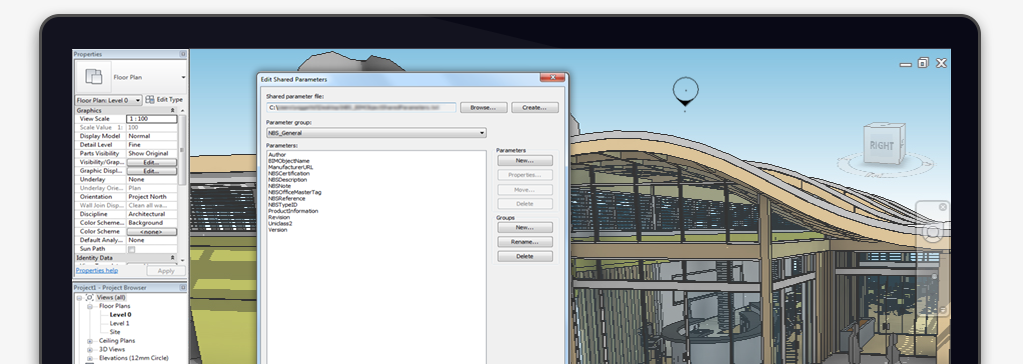
The NBS BIM Object Standard defines requirements for the information, geometry, behaviour and presentation of BIM objects, and enables greater collaboration across the construction industry. In addition, the Shared Parameter file and BIM template files have been developed to align with the standard, and are also available for download.
How NBS Shared Parameters can help you
Shared parameters can be added to families or projects and then reused by multiple other families and projects, reducing rework and increasing consistency. You can add specific data that has not been predefined in the family file or the project template.
If you create a shared parameter and add it to family categories, you can tag and annotate with that information in your model. You can also create a multi-category schedule with shared parameters in Autodesk Revit.
What are shared parameters?
Shared parameters are data definitions stored separately to a Revit project or family. Therefore, the file can be accessed by many various family files and projects. The parameters (as placeholders for information) are shared across the families or projects, but any values or data inserted within those property fields are not automatically shared.
The file can be placed in a central network location for users to access it. The download is a .txt file but should not be edited manually.
Properties
The NBS BIM Object Shared Parameters file contains property definitions relative to the following groups:
- NBS_General.
- COBie.
- All properties associated with the IFC 2x3 and IFC 4 schemas.
- NBS_Data.
- Parametrics.
- Materials.
Related articles
The following articles on NBS BIM objects and NBS templates will help you with applying the NBS BIM Object Standard to your daily work:
- NBS BIM objects
- NBS Templates
Download the tables
The current status of the classification tables is listed below. (See also: change log)