Modern building design has seen a focus on lightweight construction for mid-to-high rise buildings with curtain walling becoming an increasingly popular choice – driving aesthetically-led projects that seek to maximise light and achieve a contemporary finish.
However, the fire safety performance of the building envelope must remain a primary consideration, with the risk of fire spreading from floor to floor a key concern. While curtain walling is an aesthetic choice, the systems that protect it must be performance led.
Under the Building Safety Act, it is also a necessity to specify accurate fire safety systems at the design stage – and to ensure these will work for the lifetime of the building. A failure to do so correctly could compromise how compartmentation works to prevent the spread of fire within the building, and for façades this concern is specifically floor to floor.
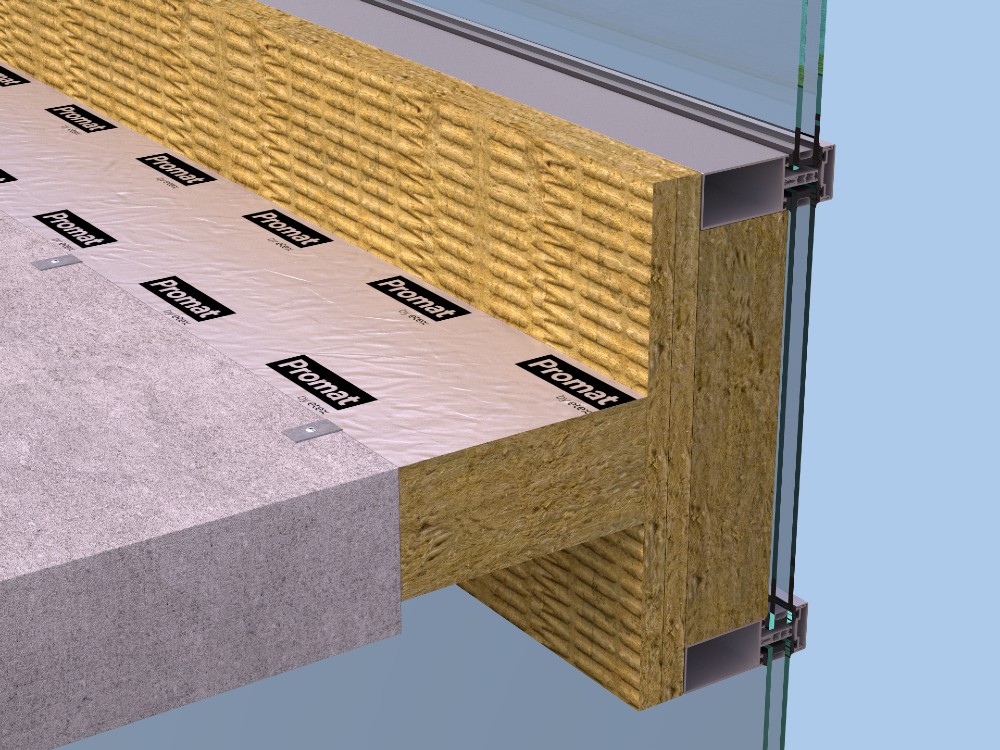
Due to the nature of a curtain wall façade, the perimeter slab edge cannot touch the façade itself as the design must allow for movement between the two rigid materials of the slab and façade. Therefore, a gap is left at the slab edge – and the gap here is the primary concern, any gaps must be fully sealed to ensure that no smoke or fire can pass from one floor to another – even after being subjected to building movement.
Slab edge fire stops provide a tested solution to deliver the level of fire resistance required. Commonly this will be between 60mins and 120mins, depending on the fire performance of the slab edge.
A number of factors need to be considered to ensure a passive fire protection system that is compliant with Part B of the Building Regulations and meets the need to demonstrate fire safety requirements under the BSA.
Key considerations in specifying fire stopping for curtain walling
As with all passive fire protection systems, the interfacing between materials is an essential consideration. For a perimeter slab edge fire stop this means testing must be carried out in line with EN 1364-4 to ascertain how the system responds to fire as a whole. While the curtain wall façade is generally non-fire rated, the role of the fire stop is essential to prevent the spread of fire from floor to floor around the perimeter of the building. EN1364-4 is a European test standard for determining the fire resistance of non-load-bearing curtain walling against exposure to fire, focusing on preventing fire spread between floors.
Additionally, it is important to accommodate movement which is prevalent in curtain walling façades. It is vital that the fire stop maintains compartmentation by incorporating the flexibility needed to allow for movement without any gaps or tears compromising the performance of the fire stop.
Environmental factors, such as wind, loading and unloading, and settlement can all create movement in a building. Although not mandatory to ensure best practice, prior to the EN 1364-4 you should also undergo movement testing, subjecting the material to movement cycling according to the European Assessment Document (EAD). In line with this, Paraflam Ultra, the new perimeter fire stop for FSi Promat, has been subjected to the requirements of EAD 350141-00-1106.

Installation is, as always, essential to the performance of fire stopping and it is important that manufacturers continue to issue guidance to ensure firestopping is fitted in line with the test solution. FSi Promat offers technical support at all stages of a project, from design and specification through to installation.
As a manufacturer, FSi Promat is happy to share its expertise and to support principal designers and contractors with site visits where necessary to ensure correct specification and installation.
This supports a best practice scenario where the risk across all aspects of the fire safety system is minimised. In looking at best practice it is also important to consider the scope of testing. As with all passive fire protection systems the sheer volume of applications and material interfaces would make a tested standard for every scenario impossible.
Specific guidance around what best practice looks like in the protection of curtain walls against the threat of fire would create a level playing field and ensure that systems were specified accurately at an early stage in the project. As a manufacturer, FSi Promat will always advise on best practice and support projects with third-party certification details, but there remains a need for best practice to be enforced across the industry.
This has already been recognised with the CWCT setting up a specialist group to look at the issue of fire safety in facades, while the ASFP has in the recent past issued additional guidance around the use of passive fire protection in facades.
As the focus on enhanced safety in construction intensifies, clarity is vital and it is essential that clear test standards exist along with installation guidance. As this moves forwards, the role of third-party testing and evaluation in ensuring systems can demonstrate compliance to support confident specification is essential.
With highly responsive technical support, FSi Promat is committed to ensuring curtain walling façades are supported by demonstrated technical performance of fire stopping systems to protect against the spread of fire.
Find out more about the FSi Promat Façade Fire Protection Range.