The need to build more homes, more quickly, has not changed. If anything, the pressure has intensified. However, the conversation around Modern Methods of Construction has evolved.
Where MMC was once widely presented as the solution to the industry’s productivity challenges, recently, a series of high-profile issues, particularly in volumetric modular construction, have prompted a more measured response. Housing providers, insurers, and fire authorities are now asking more detailed questions about performance, durability, and long-term risk.
For specifiers, this is a positive development. The focus is moving beyond innovation for its own sake and towards a more practical question: which systems can consistently deliver safe, compliant, and robust homes at scale?
Not all MMC is equal
MMC is often discussed as if it were a single approach. In reality, it encompasses a wide range of systems with very different characteristics.
Category 1 – volumetric construction – involves fully finished modules manufactured off-site and assembled on-site. While these systems offer speed, they also introduce complexity in transportation, installation, and potentially in long-term performance.
Category 2 – panelised systems – take a different approach. Structural elements, such as storey-high aircrete wall panels, are manufactured offsite, then transported and assembled onsite.
This type of system retains much of the flexibility and resilience of traditional construction while still delivering the speed advantages of offsite manufacture.
As industry experience has shown, distinction matters. It is not MMC itself that introduces risk, but how the system is designed, tested and implemented.
Balancing speed with certainty
Specifiers are working within an increasingly demanding regulatory environment. The Building Safety Act, alongside proposed reforms to construction product regulation, is driving greater accountability and a more rigorous, evidence-based approach to performance.
At the same time, fire safety and moisture risk remain key considerations. The London Fire Brigade’s Thematic Report on Modular Construction, published in September 2025, highlighted concerns around fire performance, system interfaces and the potential for disproportionate damage in the event of a fire. It also pointed to challenges around testing regimes and the need for clearer evidence of how systems perform in real-world conditions.
Prefabricated systems that incorporate insulation and internal linings at the factory stage can be more vulnerable to moisture exposure during transport, storage, and installation. Once moisture is introduced, it can be difficult to detect and even harder to remediate.
None of this suggests that MMC should be avoided, but it does reinforce the need to select systems where risk is understood and effectively managed.
Why masonry still sets the benchmark
Against this backdrop, it is worth revisiting what makes masonry construction so widely specified.
Its performance is predictable, its detailing is established and its durability has been proven over decades, if not centuries. Masonry also offers inherent fire resistance. Aircrete, for example, is classified A1 non-combustible, meaning it does not contribute to fire load.
In terms of moisture, masonry is relatively tolerant. While water ingress is never desirable, the consequences are generally less severe than in systems that rely on timber, where prolonged exposure can lead to rot, reduced strength, or loss of structural integrity.
There is also a perception that masonry is less sustainable than alternative construction methods. However, independent research published by the Future Homes Hub found that the whole life carbon differences between masonry and timber frame homes are minimal: in the region of one to two per cent.
These factors explain why masonry remains the default choice for the majority of UK housing. It is not simply traditional; it’s a proven, reliable solution.
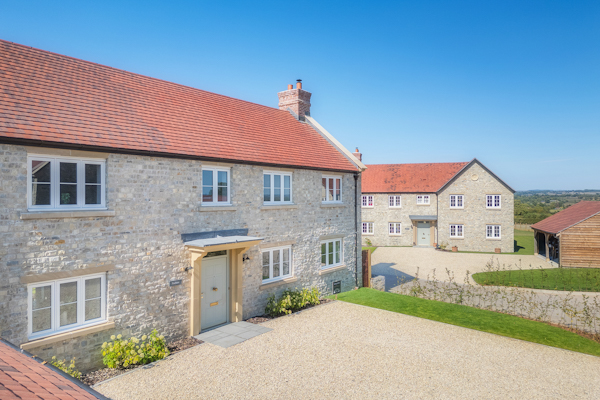
Introducing H+H Vertical Wall Panels
H+H’s Vertical Wall Panel system builds on these strengths while addressing one of the industry’s biggest challenges: speed of delivery.
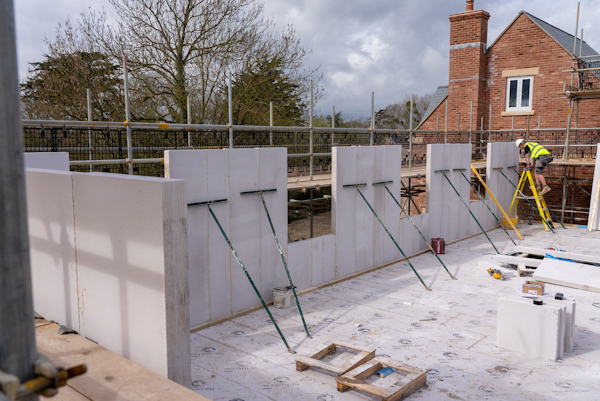
The system uses storey-high aircrete panels, manufactured offsite and craned into position to form the inner leaf of external walls, as well as separating walls and internal partitions. This allows the superstructure of a home to be constructed rapidly without altering the building's fundamental nature.
Importantly, the home's structural form remains unchanged. It is still a load-bearing masonry structure, built on standard foundations, using a material that is familiar to designers, contractors and building control bodies.
For specifiers, this point is critical. The system does not introduce a new or untested structural concept. It simply improves the way a proven construction method is delivered.
Speed without compromise
One of the most compelling advantages of the Vertical Wall Panel system is the speed at which the structural shell can be completed. When used as part of a coordinated build package that includes prefabricated floors and roof structures, the shell of a typical house can be constructed in five days. This enables the building to become weathertight much earlier in the programme, allowing follow-on trades to start sooner and reducing overall build time.
Crucially, this speed does not come at the expense of performance. The use of aircrete ensures the system retains all the inherent benefits of masonry construction, including A1 fire classification, durability, and robustness.
Unlike some other MMC approaches, there are no concealed voids or combustible structural elements introduced into the primary structure. The result is a building that behaves predictably with respect to fire, moisture, and long-term performance.
Performance aligned with future requirements
With the announcement of the Future Homes Standard, delivering high-performing building fabric is becoming increasingly important. H+H aircrete is well-suited to this; it is regularly used in Passivhaus constructions and has already been proven to help housing projects achieve the Future Homes Standard. Its thermal performance and airtightness support a fabric-first approach, helping to reduce reliance on complex building services systems.
H+H supports its products with a comprehensive suite of technical information, including thermal modelling, robust details for acoustic performance, and Environmental Product Declarations to assist with whole-life carbon assessments. This level of support is increasingly important as compliance becomes more evidence-driven and as specifiers are required to demonstrate performance at the design stage.
Restoring confidence in MMC
MMC remains an important part of the industry’s response to the housing challenge, but confidence in some approaches has been shaken. What is now emerging is a more selective approach, prioritising systems that combine innovation with proven performance.
H+H Vertical Wall Panels sit firmly in this category. Recognised by NHBC and successfully used across a growing number of developments, the system offers the efficiency benefits of offsite manufacture without introducing unnecessary uncertainty.
A pragmatic path forward
The future of housing delivery will depend on the industry’s ability to balance speed, safety, and long-term performance.
By combining a familiar, non-combustible material with an efficient off-site process, H+H Vertical Wall Panels provide a practical and scalable solution for delivering high-quality homes. For specifiers tasked with navigating an increasingly complex landscape, that combination of certainty and efficiency is likely to become ever more important.
To explore specification details, BIM objects and technical guidance, visit the H+H website and NBS Source.