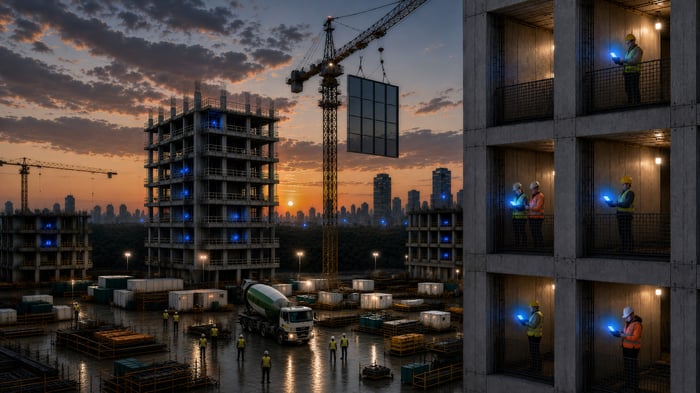
Using 3D models at the design stage improves better information to reduce production time, and during construction can greatly reduce the amount of waste in offcuts, over-ordering, and abortive work. If new-build properties were laid out and tested in a 3D model, known as a Building Information Model, the overall cost of the development could be reduced by 20% and more.
The same goes for redevelopment work or refurbishment of historic buildings. We’re currently using 3D models to investigate the past heritage of the Nottingham Arts Theatre, which 200 years ago was a chapel and a school for the poor, but now operates as a community theatre. With funding through Future Factory, an in-house, European-funded university team that helps improve businesses’ sustainability, we’re gaining understanding of the building and helping to improve its sustainable credentials for the next 200 years.
Reach for the lasers
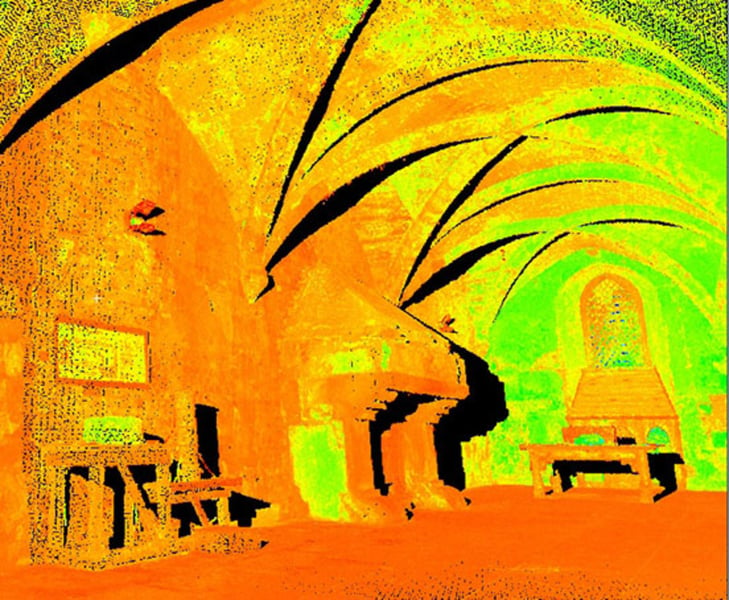
The building is scanned inside and out with millimetre accuracy using a tripod-mounted 3D laser scanner, which records all surfaces as a point in space with x-y-z co-ordinates. This is done a number of times from different angles to ensure nothing is missed out. The image above of the theatre’s undercroft shows the output data from a scan, where the different colours represent the different reflective qualities of the surface from which the laser beam has bounced.
This data is loaded into a computer and processed to link up the points on each of the scans to form a 3D model. The scanner also collects images and this information is overlaid each of the scans to add true colour.
3D scanning technology has many uses in recording existing buildings. In the event of disaster such as a water leak, fire or vandalism, a 3D model could be used as the basis for recreating the building, providing cost details for insurance purposes, or to stand as a record in the event the building is unsalvageable.
The laser scanner data feeds into a computerised 3D model attached to a number of databases, which provides a means for people to access critical information that will ensure the theatre is run sustainably into the future. In the future rather than trawling through masses of information, managers, visitors and conservation officers can use a 3D model to quickly find the specific information they need about the historic significance of the building, or a feature of it, as part of refurbishment or restoration work.
This 3D model can also be used as a source of information on lighting, heating and cooling systems, which can help identify energy efficiency improvements and other enhancements to the building’s sustainability.
It can be linked to smart electric and gas meters, giving a reading of the amounts of energy used to identify ways to be more energy efficient. Combining a 3D model with a thermal imaging camera, we can locate areas of high heat loss that need better insulation.
Revealing hidden detail
Laser scanners can also reveal details of the building not readily apparent to the human eye. It’s not unusual to identify hidden or lost features such as where windows or doors once were, or determine where a building has been revised, extended or had details changed after looking at the images produced by the scanner.
It’s a technology which could be used on an extremely wide scale. For example, English Heritage has 375,000 listed buildings, which generates approximately £11 billion per year of work for the construction industry. Many of these buildings would surely benefit from the advances in digital technology we see today in order to help lower costs and sustain them.
Together with Professor Benachir Medjdoub, Professor of Digital Architectural Design, I’ve already begun producing of laser-scanned 3D model of the Nottingham Arts Theatre, a process that will create a 3D blueprint for the future plans for the building. The better the technology used to analyse our heritage, the more intelligence we have at our fingertips to help us manage it.
This article was originally published on The Conversation. Read the original article.