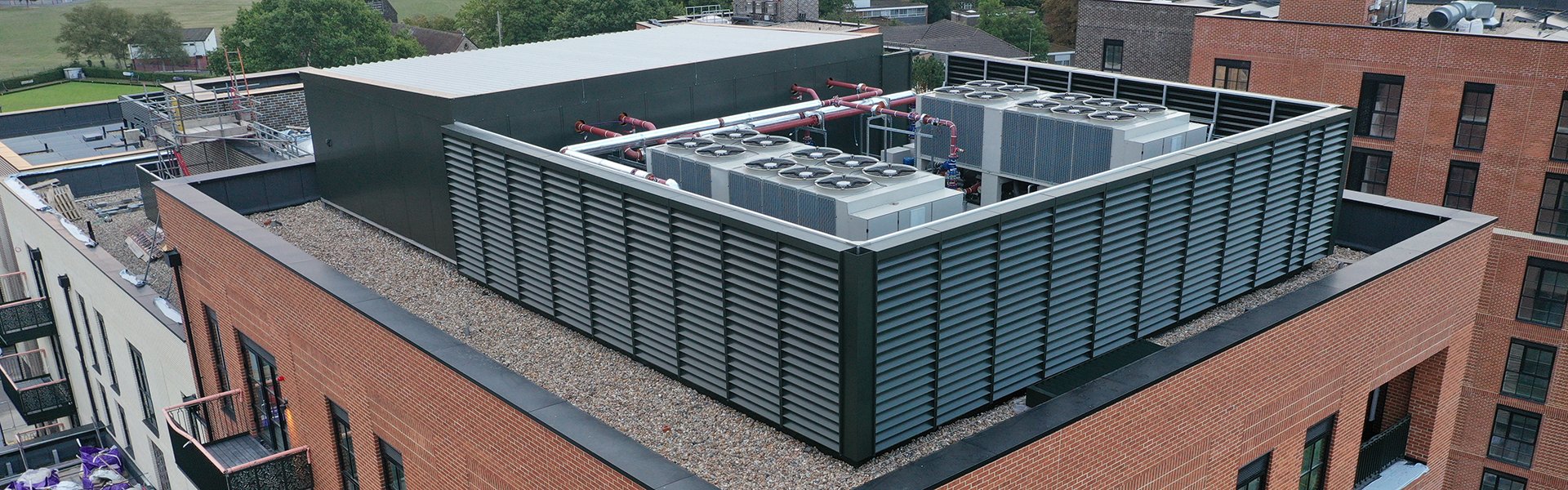
Plant enclosures and platform systems are essential components in modern building design. Typically, they provide structural support, noise attenuation, aesthetic improvement, and environmental protection for externally located building services plant and equipment. Housing building services equipment in this way is not a new phenomenon, and the practice is increasing for good reasons.
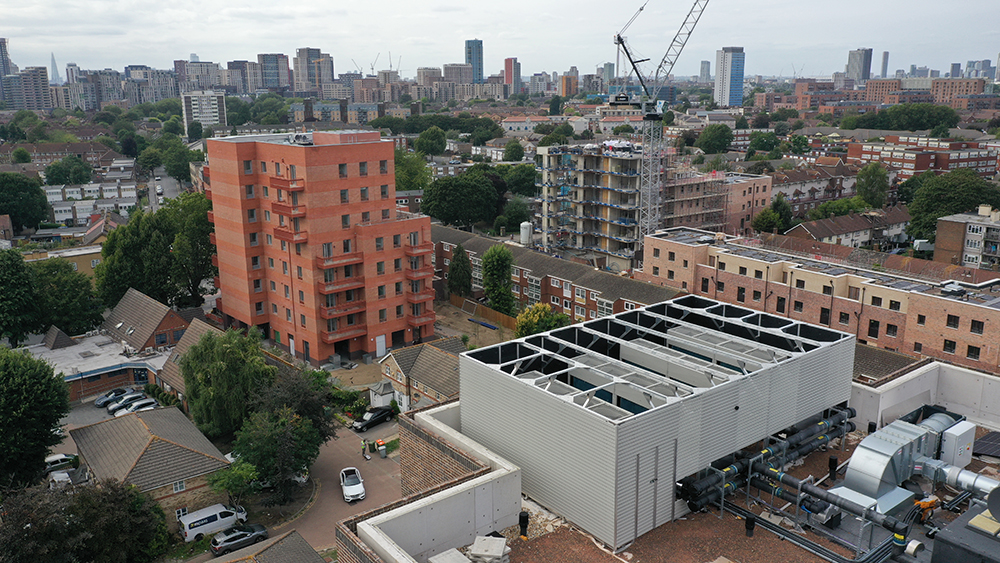
For example, the transition away from gas-fired heating systems toward low-carbon technologies (such as air-source heat pumps) has significantly increased the volume and complexity of building services equipment located externally and on building roofs. Unlike traditional gas boilers, which were typically housed in internal plantrooms or an adjacent energy center, heat pumps require substantial external space and structural support. This transition places greater emphasis on the design and specification of plant enclosure and platform systems, which must now accommodate heavier loads and increased airflow requirements, as well as more intricate service coordination.
Due to the often bespoke nature of these plantrooms and platforms, precise and coordinated specification has never been more important. This article explores how Uniclass classification Ss_30_12_64_65 ‘Plant enclosure and platform systems’ can be used to structure specifications effectively, and how software like NBS Chorus and NBS Source can support architects and building services engineers in maintaining the ‘golden thread’ of information throughout the building life cycle.
The importance of specification
Plant enclosures and platform systems are rarely off-the-shelf solutions. Each installation must account for site-specific variables such as structural loading, access requirements, weather exposure, and integration with mechanical and electrical services. Without a tightly defined specification, there is a risk of misalignment between design intent and delivered performance. A robust specification ensures that all members of the design team are working from a shared understanding of the system’s requirements.
Access and maintenance
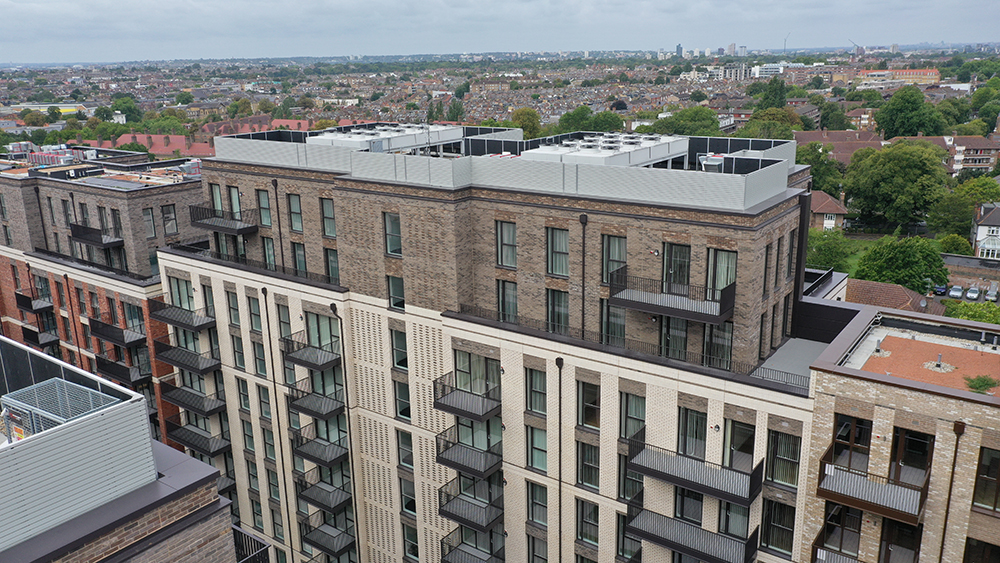
Safe and efficient access to rooftop plant is a critical aspect of platform design. Platforms should incorporate compliant walkways, guardrails, and access ladders or stairs – all designed in accordance with relevant health and safety regulations. Early planning for maintenance access not only improves safety but also reduces operational costs over the building’s life cycle. Including these elements in the specification ensures that they are not overlooked during procurement or construction.
Environmental and acoustic performance
With more equipment being located externally, managing environmental and acoustic impacts becomes increasingly important. Plant enclosures can be specified with appropriate acoustic panels, vibration isolation and weather protection. These measures help mitigate noise pollution, protect sensitive equipment, and contribute to the building’s overall energy performance and occupant comfort.
Using Uniclass Ss_30_12_64_65 ‘Plant enclosure and platform systems’
Uniclass provides a structured classification system that supports consistency and clarity in specification. It allows for a constituent ‘System outline’ clause to act as a ‘skeleton’, which can link to a range of related clauses. For Ss_30_12_64_65 'Plant enclosure and platform systems', this means that a range of important performance, product, execution (typically installation) and completion clauses are linked to the system outline. This clause structure allows specifiers to ensure that all integral components of the plant enclosure and platform system are properly specified, coordinated and documented.
Using NBS Chorus to maintain the ‘golden thread’
NBS Chorus enables specifiers to embed detailed, structured information into project documentation from the outset. By using Chorus, architects and engineers can ensure that the specification remains consistent and traceable across design, procurement, construction and operation. This continuity, often referred to as the 'golden thread', is vital for compliance, safety and long-term asset management.
Collaboration across the building life cycle
Effective specification is not a solitary task. NBS Chorus facilitates collaboration between multiple project team professionals such as architects, building services engineers, structural engineers and contractors. NBS Source provides a link between specifiers and manufacturers for NBS Chorus users to instantly add selected products directly into their specification. By using shared digital tools and classification systems, project teams can ensure that plant enclosure and platform systems are integrated seamlessly into the overall building design. This collaborative approach reduces risk, improves buildability, and supports better outcomes for clients and end users.
The role of modular construction
Modular construction offers a highly effective solution for delivering plant enclosure and platform systems. The off-site fabrication of components in controlled environments allows modular systems to be assembled with greater precision, speed and safety. It also reduces waste. This approach reduces on-site disruption, shortens construction timelines, and aids quality assurance. For roof-mounted applications, modular platforms can be pre-engineered to integrate seamlessly with structural supports, services, and access systems, ensuring an elevated level of coordination and reducing the risk of installation errors. As demand for rooftop services grows, modular construction provides a scalable and efficient method to meet evolving building performance requirements.
Simplifying specification with NBS Source
NBS Source provides a curated library of manufactured products that can be easily integrated into specifications. Configured Platforms, a leading provider of modular plant platform systems, now offers a range of products on NBS Source. These listings include detailed performance data, certifications, and digital objects that streamline the specification process and support compliance with Uniclass.
Conclusion
As building systems become more complex and performance-driven, the role of specification becomes increasingly strategic. By aligning with Uniclass in NBS Chorus and collaborating across disciplines, architects and building services engineers can ensure that roof-mounted plant platforms are delivered with precision and confidence. With trusted manufacturers like Configured Platforms now featured on NBS Source, the path to accurate and efficient specification has never been clearer.
NBS Source
Configured Platforms Ltd | Overview | NBS Source
Plantroom | Configured Platforms Ltd | NBS Source