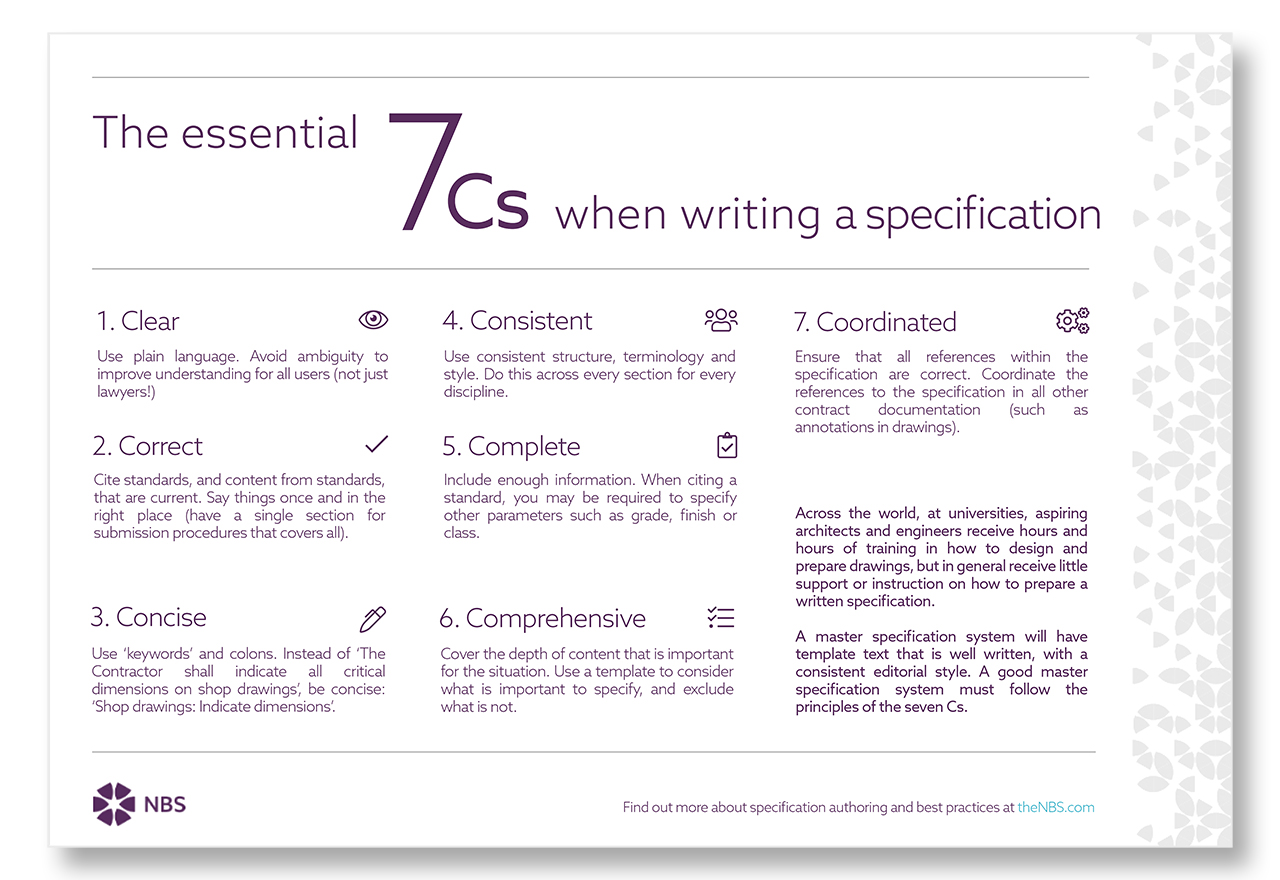
Across the world, at universities, aspiring architects and engineers receive hours and hours of training in how to design and prepare drawings, but in general receive little support or instruction on how to prepare a written specification.
A master specification system will have template text that is well written, with a consistent editorial style. A good master specification system must follow the principles of the seven Cs.
1. Clear
Use plain language. Avoid ambiguity to improve understanding for all users (not just lawyers!).
2. Concise
Use 'keywords' and colons. Instead of 'The Contractor shall indicate all critical dimensions on shop drawings,' be concise: 'Shop drawings: Indicate dimensions'.
3. Correct
Cite standards, and content from standards, that are current. Say things once and in the right place (have a single section for submission procedures that covers all).
4. Complete
Include enough information. When citing a standard, you may be required to specify other parameters such as grade, finish or class.
5. Comprehensive
Cover the depth of content that is important for the situation. Use a template to consider what is important to specify, and exclude what is not.
6. Consistent
Use consistent structure, terminology and style. Do this across every section for every discipline.
7. Coordinated
Ensure that all references within the specification are correct. Coordinate the references to the specification in all other contract documentation (such as annotations and drawings).