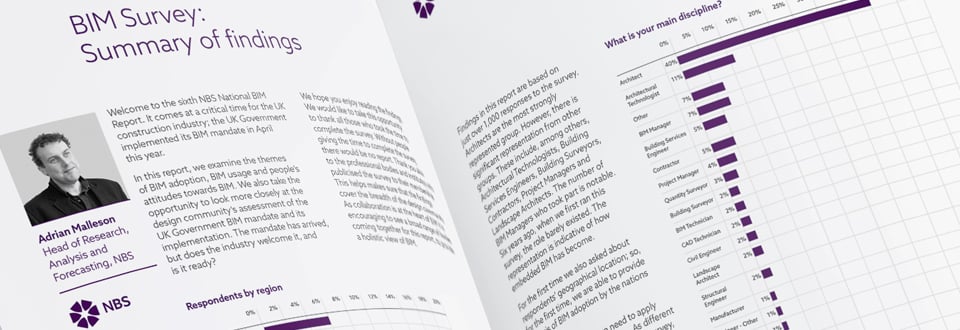
The National BIM Report is the most comprehensive analysis of the state of BIM within the UK construction sector.
The 2016 report is the sixth such study and with consistent set of core questions we are able to present a unique year-on-year comparison drawing on the insight of over 1000 construction industry professionals.
We've now produced a version of the report just for manufacturers which includes comprehensive analysis of this years' findings alongside specialist insight and case studies focussed on real-world BIM implementation.
Download the National BIM Report for Manufacturers 2016 (.pdf, 3.19Mb)
Read the articles in the National BIM Report for Manufacturers 2016
What’s in the report?
- An introduction to the report from Director of the National BIM Library, Ian Chapman
- A summary of this year’s findings from the NBS National BIM Survey
- Feature content exploring; BIM and the digital revolution, Origins3 Studio's transition to BIM, presenting product information fit for BIM, Mott MacDonald's experience meeting the mandate, BIM implementation experiences from Twinfix, Bruynzeel Storage Systems, Ecoprod and Ideal Standard and the impact of BIM on product selection throughout the project timeline.
Who is it for?
- Manufacturers – already embarking on BIM or just starting to consider it
The findings at a glance
BIM adoption
- A majority are now aware of and using BIM on at least some of their projects (54%), 42% said they were just aware of BIM, and 4% were neither aware nor using.
- Regardless of where they are now, in a years' time 86% expect to be using BIM on at least some of their projects - and that number increases to 97% in five years' time making BIM universal and routine assuming good intentions are realised.
Finding out about BIM
- Almost half of respondents describe themselves as being 'very' or 'quite' confident of their BIM knowledge and skills, leaving a majority who are not. 23% describe themselves as being 'in between', while 28% describe themselves as 'not very' or 'not at all' confident in BIM.
BIM objects
- 63% of respondents create objects as needed for a project - 67% create objects in-house and re-use - both inefficient and risky.
- Designers are looking for more BIM objects to be made available to them - 71% said they need manufacturers to provide them with BIM objects.
The BIM advantages
- 63% believe BIM will help bring about a 33% reduction in the initial cost of construction and whole life cost of built assets.
- 57% believe BIM will help bring about a 50% reduction in the time from inception to completion for new-build and refurbished assets
- 39% believe BIM will help bring about a 50% reduction in greenhouse gas emissions in the built environment.
- Less than a third believe that BIM will help create a reduction in the trade gap between total exports and total imports for construction products.
Download the National BIM Report for Manufacturers 2016 (.pdf, 3.19 Mb)
Related reading
National BIM Report - access previous years' reports and related articles.
Related NBS Services
The NBS BIM workflow is powered by a suite of tools that enable you to produce co-ordinated digital design information. Find out more about NBS services for BIM projects.