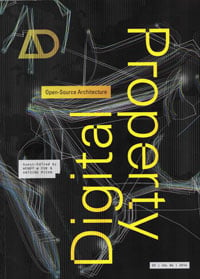
Digital Property: Open-Source Architecture
Guest Edited by Wendy W Fok and Antoine Picon
 The collaborative nature of digital design and production poses particular challenges for industries and disciplines built on traditional ideas of 'ownership' in legal, economic and ethical terms.
In a world where, thanks to 3D printing, anyone may soon be able to 'print out' an object or structure from a digital file, will designers still be able to exert the same creative rights they always have or will they need to develop new practice and payment models? Indeed, how will wider teams working globally be appropriately accredited and compensated?
In the latest edition of Architectural Design guest editors Wendy W Fok and Antoine Picon take a deep delve into the impact of 'digital' on architectural professions through a highly engaging collection of articles that feature the work of designers developing new and innovative approaches to practice by focussing on new avenues for commercialisation - with an emphasis on process-based products rather than objects.
A deep delve into the impact of 'digital' on architectural professions through a highly engaging collection of articles.
Of particular note; David Ruy explores whether the architects of the future will first and foremost be focussed on service provision or creative roles. Antonine Picon delves into the historical context. Carlo Rattie and Matthew Claudel of MIT's Sensable City Lab explores how end users can be involved in building design via an adaptation of the A/B testing method used in software design and Jose Sanchez explores how gamification of urban design can increase our understanding of ecological and energy concerns. Rounding out the issue the ever-controversial Counterpoint section sees Neil Leach, Professor of Digital Design at the European Graduate School and Visiting Professor at Harvard Garduate School of Design, argue the case that the entire history of human culture is built on a constant process of replication in 'The Culture of the Copy'.
Again, AD provides an insightful read and offers readers pause for thought in a world focussed on ever-quicker digitalisation.
About this book
Digital Property: Open-Source Architecture is part of the Architectural Design series (05:16) and was published by Wiley in September 2016 and is available to buy from the publisher. The title is published in softback (ISBN 978-1-118-95498-0).
About the authors
Wendy W Fok is a trained architect, practiioner and educator. She is creative director/ founder of WE DESIGNS which offers creative stategies for the built environment, and works at Resilient Modular Systems - a socially-missioned venture that focusses on innovative modular components using hybridised composite materials for the building industry. Fok is also an Assistant Professor of Integrated Design ant Parsons and completed her Doctor of Design at the Harvard GSD.
Antoine Picon is a theorist and historian. He is the G Ware Travelstead Professor of the History of Architecture and Technology at Harvard GSD. He works on the hsitory of architectural and urban technologies from the 18th century to the present.