Cracking concrete and costly repair bills could be a thing of the past as university researchers trial technologies to deliver 'self-healing' concrete.
The problem with concrete
Concrete is a popular choice for large-scale structures. Bridges, tunnels, roads and buildings are all built from the stuff. But, as a construction material, it's not without its problems. Every year billions of pounds are spent maintaining, fixing and restoring concrete structures, £40 billion in the UK alone.
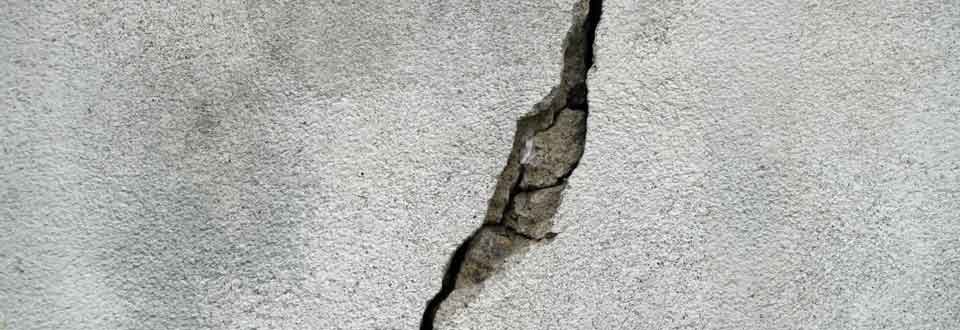
Significant problems can occur as micro-cracks emerge allowing water, carbon dioxide and chlorine ions to seep into the structure. The resulting carbonation has the potential to cause sulphate-related degration of the concrete itself and corrode any reinforcements.
But what if materials could be more robust, effectively healing themselves, preventing problems before they have chance to cause potentially catastrophic damage? That's the ambitious aim of a project team, drawing on researchers at Cardiff University, the University of Cambridge and the University of Bath who are looking at biomimetic multi-scale damage immunity for construction materials.
One of the first pieces of work to emerge from the Materials for Life (M4L) project is a multi-scale self-healing system in concrete using a range of inter-disciplinary technologies.
The science behind self-healing concrete
The project team have investigated individual and combined healing techniques in the laboratory and at the field-scale. The individual healing techniques address damage at various lengths and timescales. These include encapsulating healing agents, bacterial healing agents, crack closure using shape memory polymer tendons and repeated supply of healing agents through vascular networks.
We explore how these work in a bit more detail below:
Healing agents - Microcapsules containing various healing agents are mixed with regular concrete mixes. Once the material sets the capsules sit untouched until a crack ruptures a capsule releasing the healing agent into the crack plane. This stops the ingress of harmful substances and helps recover the strength of the structure.
Bacterial action - A bacterial self-healing solution is included within the concrete mix. In their trails scientists found that the bacteria bacillus pseudofirmus infused into lightweight aggregates in the form of pearlite worked best.
Memory polymer tendons - Memory polymers serveto close any cracks that develop. In a trial these were manufactured into 'tendons' tied onto the reinforcement which could be triggered by a heating wire system.
Repeated supply of healing agent through vascular networks - Artificial channels were strategically placed within concrete structures through which healing agents could be supplied under pressure.
Combining these techniques to form a multi-scale healing system has shown to improve the overall healing efficiency with respect to strength recovery.
Putting self-healing concrete to the test
Costain has built a full scale concrete structure in South Wales which includes five wall panels incorporating different combinations of self-healing techniques and this project has been an important step in evaluating the feasibility of self-healing concrete.
For many of these techniques application has proven to be straightforward meaning the team's attention now turns to identifying suitable applications for the technology. While no one technique would act as a 'silver bullet' to damage and stress, hopes are high that a combination of techniques have significant potential to work together to reduce the need for costly inspection, maintenance and repair and to prolong the lifespan of the structure.
Given the scale of the UK's repair bills, it's not hard to see why the team are attracting significant interest and have already landed an awards nod in the Studies & Research category of the ICE Wales Cymru Awards. To keep up-to-date with the latest from the M4L team you can follow @materials4life on Twitter.