Given the survival of ancient structures, this may seem curious. The critical difference is the modern use of steel reinforcement, known as rebar, concealed within the concrete. Steel is made mainly of iron, and one of iron’s unalterable properties is that it rusts. This ruins the durability of concrete structures in ways that are difficult to detect and costly to repair.
While repair may be justified to preserve the architectural legacy of iconic 20th-century buildings, such as those designed by reinforced concrete users like Frank Lloyd Wright, it is questionable whether this will be affordable or desirable for the vast majority of structures. The writer Robert Courland, in his book Concrete Planet, estimates that repair and rebuilding costs of concrete infrastructure, just in the United States, will be in the trillions of dollars – to be paid by future generations.
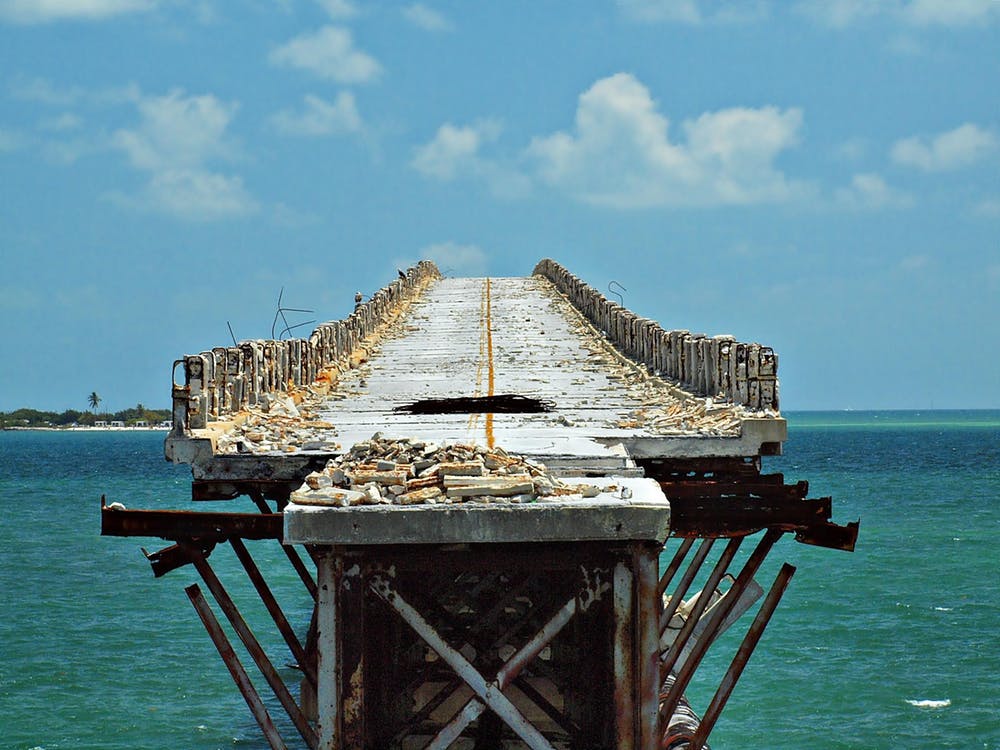 Old bridges need new money to replace. Phil's 1stPix/Flickr.com, CC BY-NC
Steel reinforcement was a dramatic innovation of the 19th century. The steel bars add strength, allowing the creation of long, cantilevered structures and thinner, less-supported slabs. It speeds up construction times, because less concrete is required to pour such slabs.
These qualities, pushed by assertive and sometimes duplicitous promotion by the concrete industry in the early 20th century, led to its massive popularity.
Reinforced concrete competes against more durable building technologies, like steel frame or traditional bricks and mortar. Around the world, it has replaced environmentally sensitive, low-carbon options like mud brick and rammed earth – historical practices that may also be more durable.
Early 20th-century engineers thought reinforced concrete structures would last a very long time – perhaps 1,000 years. In reality, their life span is more like 50-100 years, and sometimes less. Building codes and policies generally require buildings to survive for several decades, but deterioration can begin in as little as 10 years.
Many engineers and architects point to the natural affinities between steel and concrete: they have similar thermal expansion characteristics, and concrete’s alkalinity can help to inhibit rust. But there is still a lack of knowledge about their composite qualities – for example, in regard to sun-exposure-related changes in temperature.
The many alternative materials for concrete reinforcement – such as stainless steel, aluminium bronze and fibre-polymer composites – are not yet widely used. The affordability of plain steel reinforcement is attractive to developers. But many planners and developers fail to consider the extended costs of maintenance, repair or replacement.
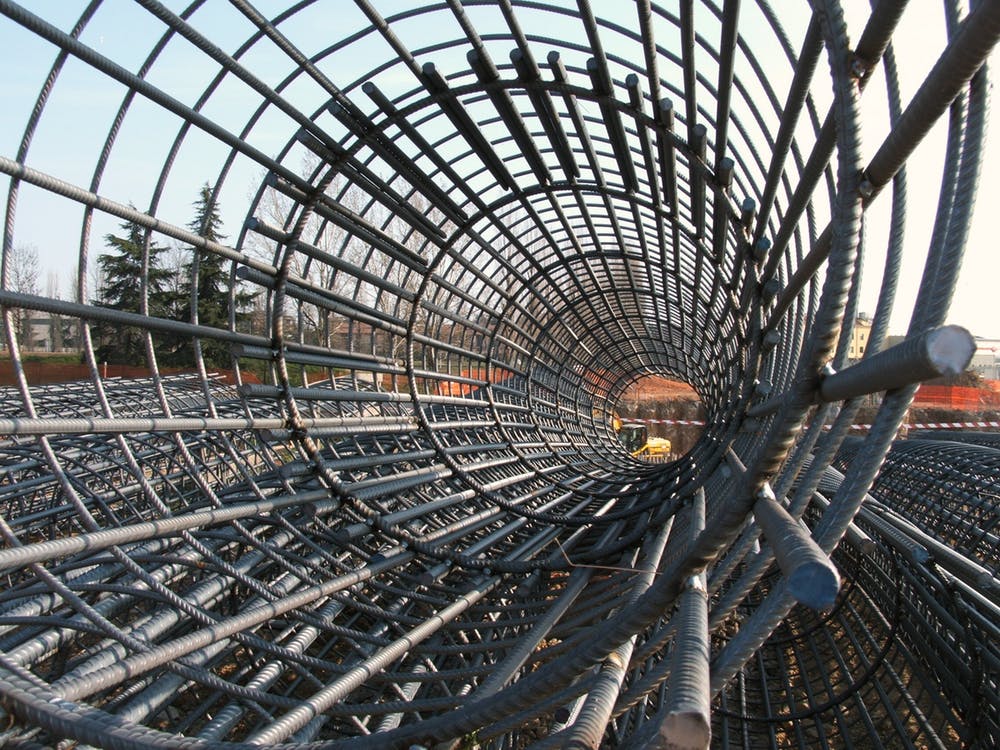
There are technologies that can address the problem of steel corrosion, such as cathodic protection, in which the entire structure is connected to a rust-inhibiting electric current. There are also interesting new methods to monitor corrosion, by electrical or acoustic means.
Another option is to treat the concrete with a rust-inhibiting compound, although these can be toxic and inappropriate for buildings. There are several new non-toxic inhibitors, including compounds extracted from bamboo and bacterially derived “biomolecules”.
Fundamentally, however, none of these developments can resolve the inherent problem that putting steel inside concrete ruins its potentially great durability.
The environmental costs of rebuilding
This has serious repercussions for the planet. Concrete is the third-largest contributor to carbon dioxide emissions, after automobiles and coal-fuelled power plants. Cement manufacturing alone is responsible for roughly 5% of global CO₂ emissions. Concrete also makes up the largest proportion of construction and demolition waste, and represents about a third of all landfill waste.
Recycling concrete is difficult and expensive, reduces its strength and may catalyse chemical reactions that speed up decay. The world needs to reduce its concrete production, but this will not be possible without building longer-lasting structures.
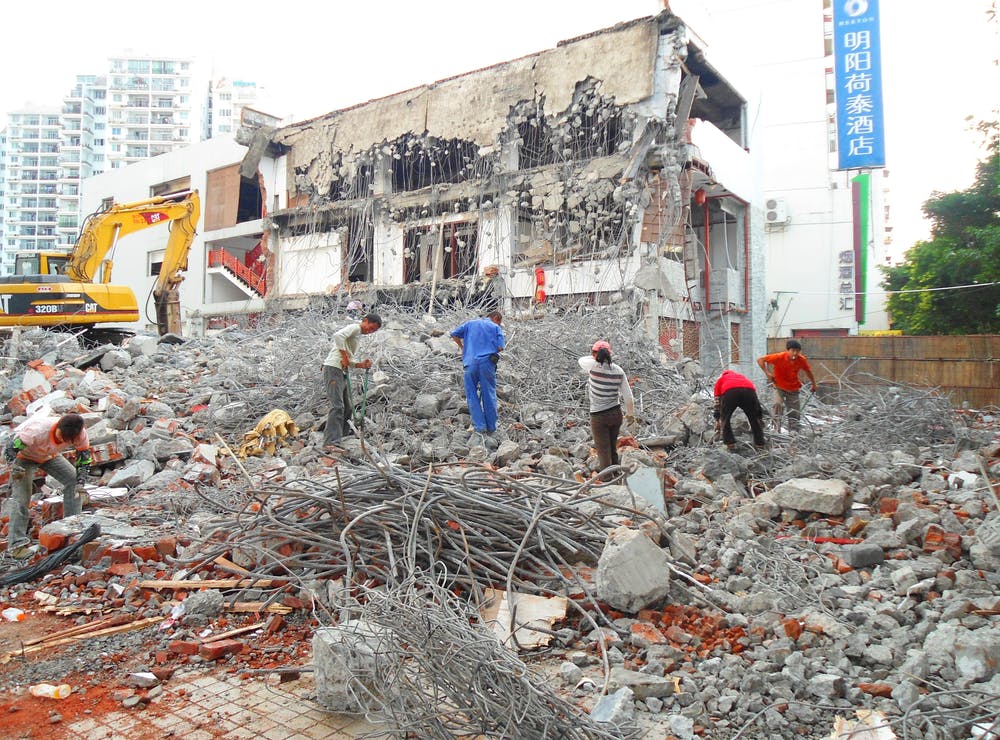 Rebar reclamation: an expensive job. Anna Frodesiak/Wikimedia Commons
In a recent paper, I suggest that the widespread acceptance of reinforced concrete may be the expression of a traditional, dominant and ultimately destructive view of matter as inert. But reinforced concrete is not really inert.
Concrete is commonly perceived as a stone-like, monolithic and homogeneous material. In fact, it is a complex mix of cooked limestone, clay-like materials and a wide variety of rock or sandy aggregates. Limestone itself is a sedimentary rock composed of shells and coral, whose formation is influenced by many biological, geological and climatological factors.
This means that concrete structures, for all their stone-like superficial qualities, are actually made of the skeletons of sea creatures ground up with rock. It takes millions upon millions of years for these sea creatures to live, die and form into limestone. This timescale contrasts starkly with the life spans of contemporary buildings.
Steel is often perceived to be inert and resilient too. Terms such as “Iron Age” suggest an ancient durability, although Iron Age artefacts are comparatively rare precisely because they rust. If construction steel is visible, it can be maintained – for instance, when the Sydney Harbour Bridge is repeatedly painted and repainted.
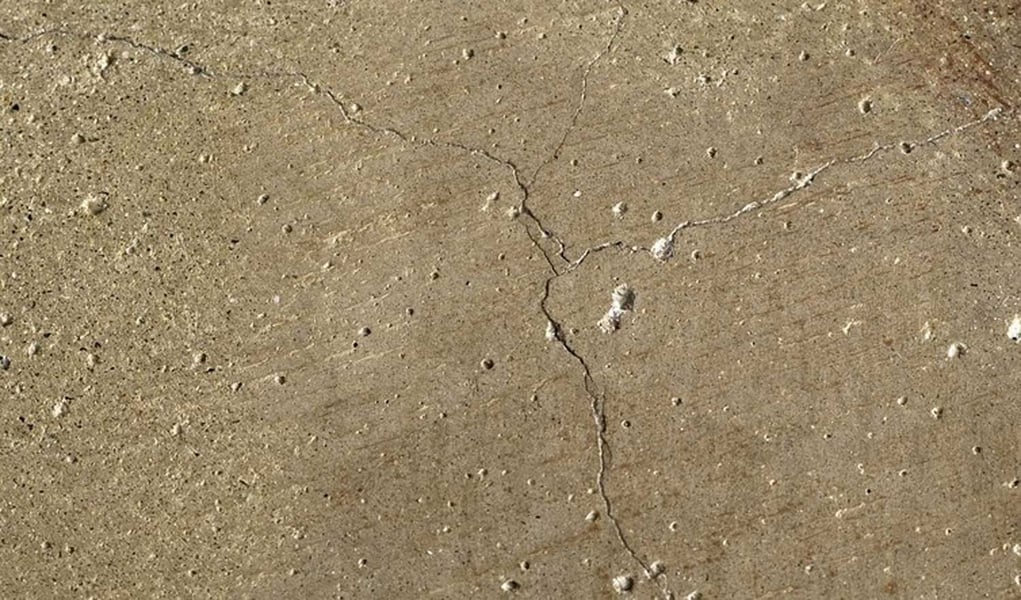
However, when embedded in concrete, steel is hidden but secretly active. Moisture entering through thousands of tiny cracks creates an electrochemical reaction. One end of the rebar becomes an anode and the other a cathode, forming a “battery” that powers the transformation of iron into rust. Rust can expand the rebar up to four times its size, enlarging cracks and forcing the concrete to fracture apart in a process called spalling, more widely known as “concrete cancer”.
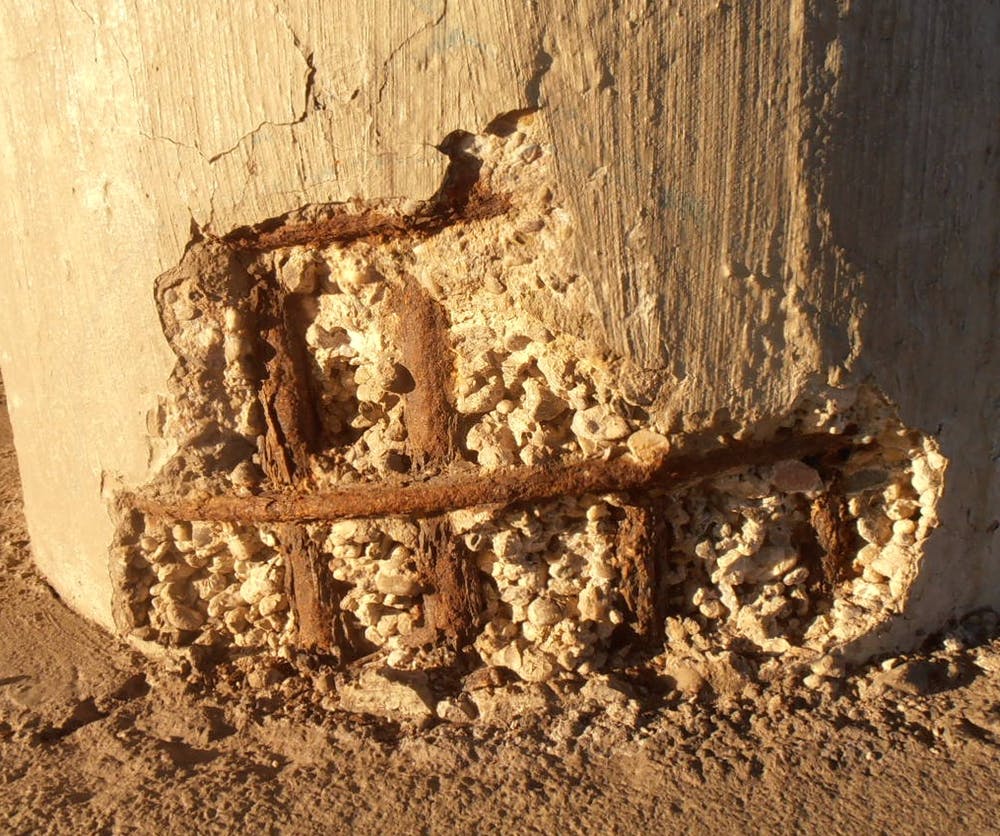 Concrete cancer: not pretty. Sarang/Wikimedia Commons
I suggest that we need to change our thinking, to recognise concrete and steel as vibrant and active materials. This is not a case of changing any facts, but rather of re-orientating how we understand and act on those facts. Avoiding waste, pollution and needless rebuilding will require [thinking well beyond disciplinary conceptions of time]((https://researchers.anu.edu.au/publications/53583), and this is especially true for the building and construction industries.
 The collapsed civilisations of the past show us the consequences of short-term thinking. We should focus on building structures that stand the test of time – lest we end up with hulking, derelict artefacts that are no more fit for their original purpose than the statues of Easter Island.
Image: The cracks are starting to show. Dean McCartney, Author provided
This article was originally published on The Conversation. Read the original article.