Billions of pounds are spent every year dealing with the resulting cracks and, in recent years, scientists have been experimenting with a range of self-healing technologies. Now researchers in Singapore have re-engineered the stuff and the resulting ConFlexPave is significantly more bendable and stronger and longer lasting as a result.
The innovation comes from the labs at the Nanyang Technological University (NTU) working in conjunction with the JTC – the lead government agency responsible for the development of industrial infrastructure.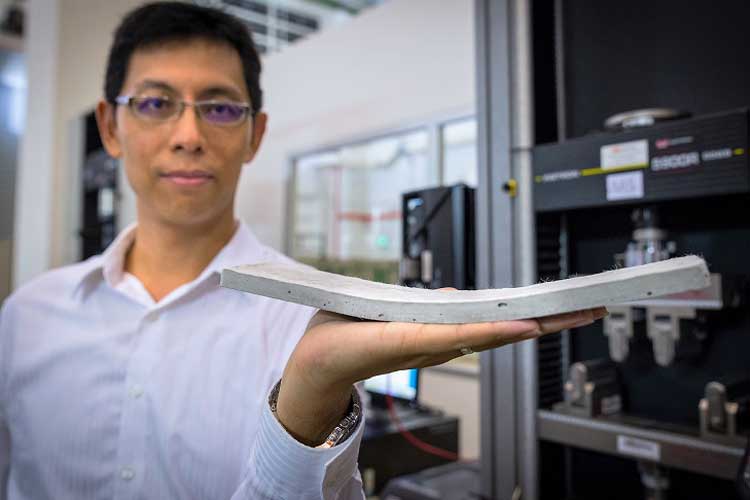 The new concrete is said to reduce time needed for road works by more than half.
The resulting precast pavement slabs are so quick and easy to install that researchers reckon installation time is less than half that of more traditional materials. Moreover, the resulting structures are said to require less maintenance.
NTU Professor Chu Jian, Interim Co-Director of the NTU-JTC Industrial Infrastructure Innovation Centre said “Our new type of concrete that can greatly reduce the thickness and weight of precast pavement slabs, enabling speedy plug-and-play installation, where new concrete slabs prepared off-site can easily replace worn out ones.”
The material is specifically engineered to have certain types of hard materials mixed with polymer microfibres. The inclusion of these synthetic fibres, besides allowing the concrete to flex and bend under tension, also enhances skid resistance.
“With detailed understanding, we can then deliberately select ingredients and engineer the tailoring of components, so our final material can fulfill specific requirements needed for road and pavement applications,” explained Prof Yang En-Hua from the NTU School of Civil and Engineering who leads the research.
“The hard materials give a non-slip surface texture while the microfibres which are thinner than the width of a human hair, distribute the load across the whole slab, resulting in a concrete that is tough as metal and at least twice as strong as conventional concrete under bending,” he added.
With detailed understanding, we can then deliberately select ingredients and engineer the tailoring of components, so our final material can fulfill specific requirements needed for road and pavement applications
Prof Yang En-Hua,
NTU School of Civil and EngineeringMr Koh Chwee, Co-Director, believes the new material will be gamechanging. “The invention of this technology will not only enable the construction industry to reduce labour intensive on-site work, enhance workers’ safety and reduce construction time, it also benefits road users by cutting down the inconvenience caused by road resurfacing and construction works,” he said.